
Passing the Fire – how art moves between bodies and generations
Art history is not static or linear; it is continuously reshaped through cross-pollinations between artists of different generations. Through dialogues, encounters, and his Prelude evenings, Titus Nouwens seeks to look at what earlier artistic practices can teach us today, in close proximity to those who shaped them. For Mister Motley, Titus writes about this infinite interweaving. In doing so, he moves alongside the work of—and the intergenerational encounters between—Louwrien Wijers, Publik Universal Frxnd, Philipp Gufler, Rory Pilgrim, Lydia Schouten, Astrit Ismaili, Sands Murray-Wassink, and Billy Morgan.
What happens to a work of art when an artist embodies it anew after more than forty years? In the spring of 2018, at Tate Modern in London, I saw American performance and video art pioneer Joan Jonas perform a live re-enactment of a work from 1976, while the original video was projected behind her. She danced, drew, sang in a giant cone, and so two versions of the same work and the same person appeared. Simultaneously, but with forty-two years in between.
The moment stayed with me. Not only because of the gentleness of the 82-year-old artist performing her own work once again. It was the feeling that a new version of – and thus a new perspective on – a historical work was unfolding before my eyes. Shaped anew in the present by the body that once created it.
I recalled this experience while reflecting on my own approach to historical performance work and how to reactivate it: live and mediated forms juxtaposed, video and performance intersecting, bringing early experiments into the present, as I had seen Joan Jonas do. At the same time, her re-performance also revealed something else: that such moments are in many cases dependent on the artist’s own body. What happens when that body is no longer there? And what if a work is not sustained by one body, but by more than one?
It is probably because of my art history studies that I tend to look for parallels between what artists are doing now and what their predecessors did. Through dialogue, I try to take a fresh look at what earlier art practices can teach us today, in the company of those who shaped them.

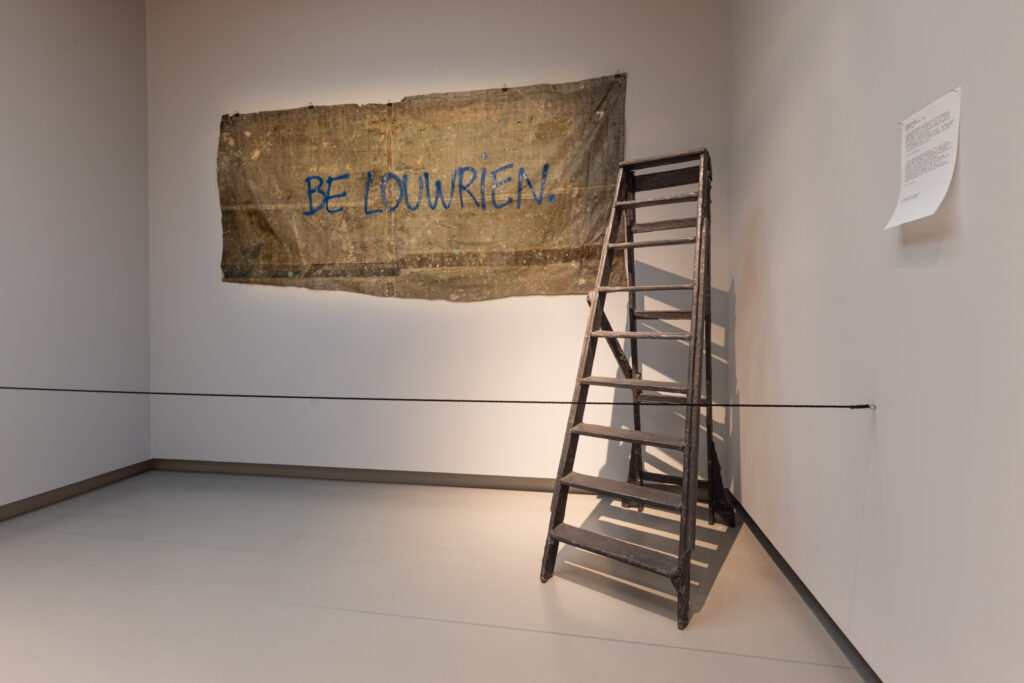
I did this last year with Prelude, a series of live programmes at various institutions in Amsterdam, and with We Live in Language: an exhibition at the Fries Museum, both featuring relatively unknown artists who are of particular significance to younger generations. The exhibition is the first solo museum presentation of Louwrien Wijers (*1941): an artist who regards writing, thinking and listening as forms of art, as “mental sculptures”. In addition to the interviews and conversations she conducted with artists from the international avant-garde of the 1970s and 1980s, I wanted to use documentation of more recent collaborations to show how this practice continues and how Louwrien’s work is rooted in intergenerational friendships, learning from each other and together finding words that give direction to the future.
For example, Publik Universal Frxnd used Louwrien’s painted text panels Tomorrow’s Language as a script in a performance about how language moves through time and generations (FLAM in 2022); Philipp Gufler realised exhibitions with a particular focus on the relationship between her metal and mental sculptures (W139 in 2023 and Nest in 2026); and Rory Pilgrim followed her during two year period for the documentary film the arrow of Time (showing every weekend from February in the cinema at the Fries Museum). A mentor and “guiding star to myself and so many”, according to Rory.
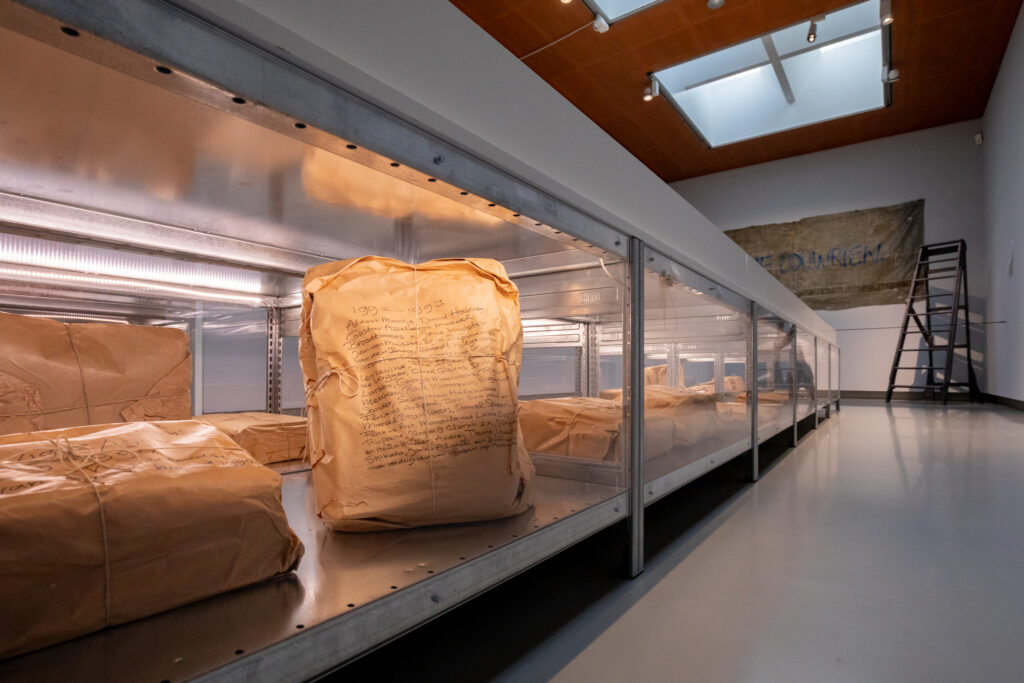
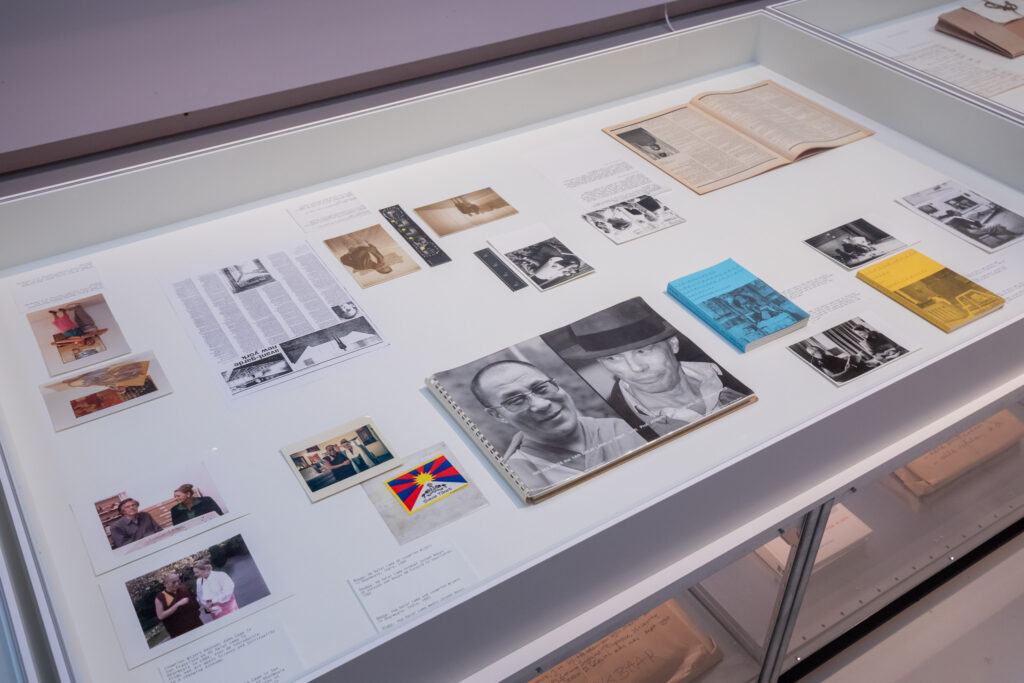
It is inspiring to look through the eyes of a younger generation of artists at an art practice that took shape in a different era. It reveals how both the practice and our way of looking at it change over time. ‘This piece is about beauty and what it means through Lydia’s eyes and mine,’ reflects Astrit Ismaili on his collaboration with Lydia Schouten for the most recent edition of Prelude.
Between time, body and space
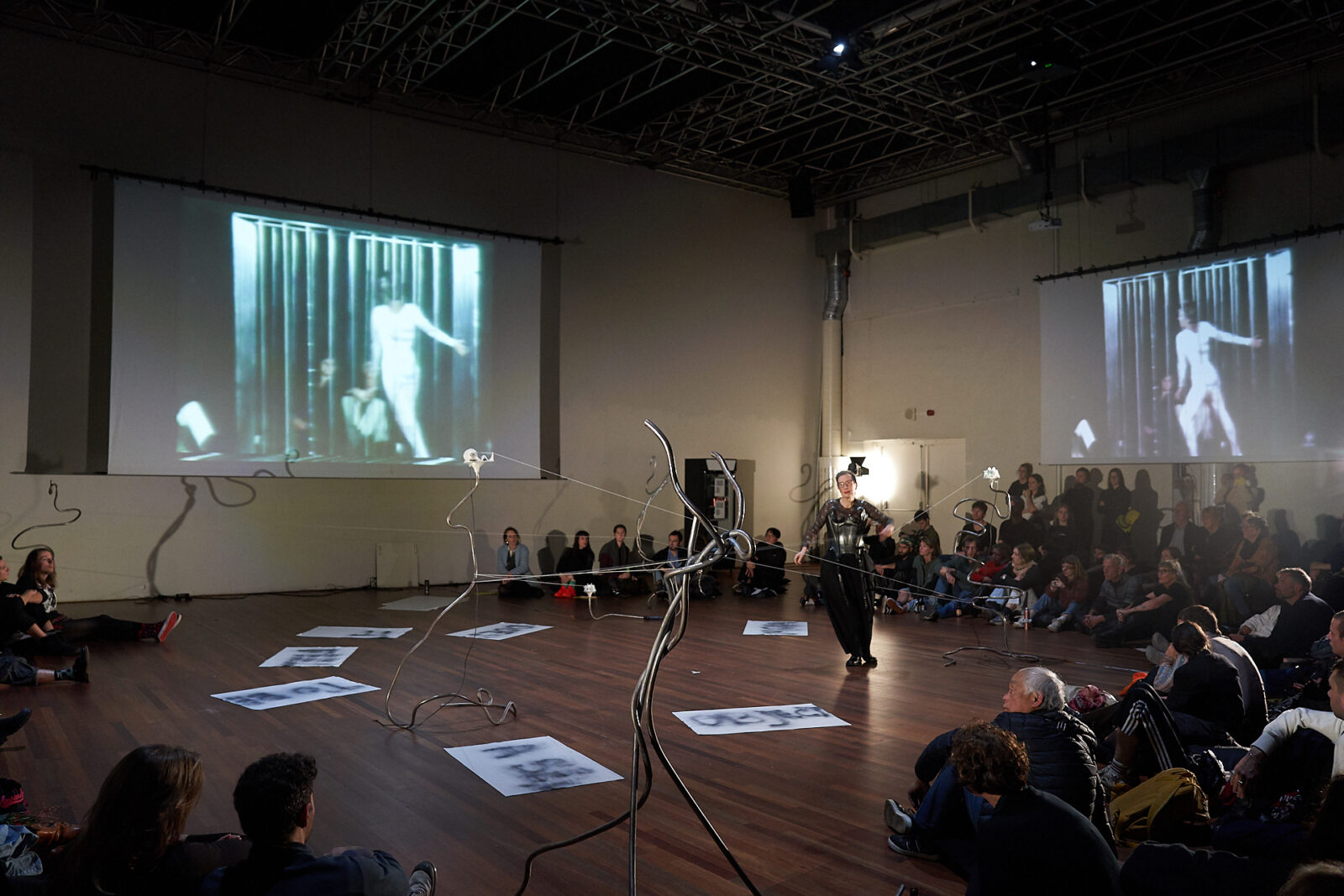
On a rainy October evening, while the streets around the theatre were filled with attendees of Amsterdam Dance Event dressed in black, Brakke Grond hosted the third edition of Prelude: a programme in which artists from different generations engage in dialogue through moving images and performance. In addition to work by Flemish performance pioneer Hugo Roelandt (b. 1950, d. 2015) and promising young artist Amina Szecsödy (b. 1995), the evening focused on the new artistic exchange between Astrit Ismaili (b. 1991) and Lydia Schouten (b. 1948): two artists who combine time-based media and the body to explore the boundaries of identity and imagination.
Early and recent video works by the artists were projected around the large stage, beginning with Lydia’s Echoes of Death / Forever Young: a work from 1986, commissioned by and broadcast on Dutch television, about the ideal of eternal youth and how television often renders the decline of beauty invisible. The video consists of a rhythmic stream of images, accompanied by short sentences, in which an advertising-like ideal body shifts to something animalistic and ultimately to a state that eludes human time and identity. Lydia previously said about this work: “The most important task of the media seems to be the destruction of chronological time (…) by presenting film and sound recordings from the past as if they were part of the present. They all become part of a frozen time”.
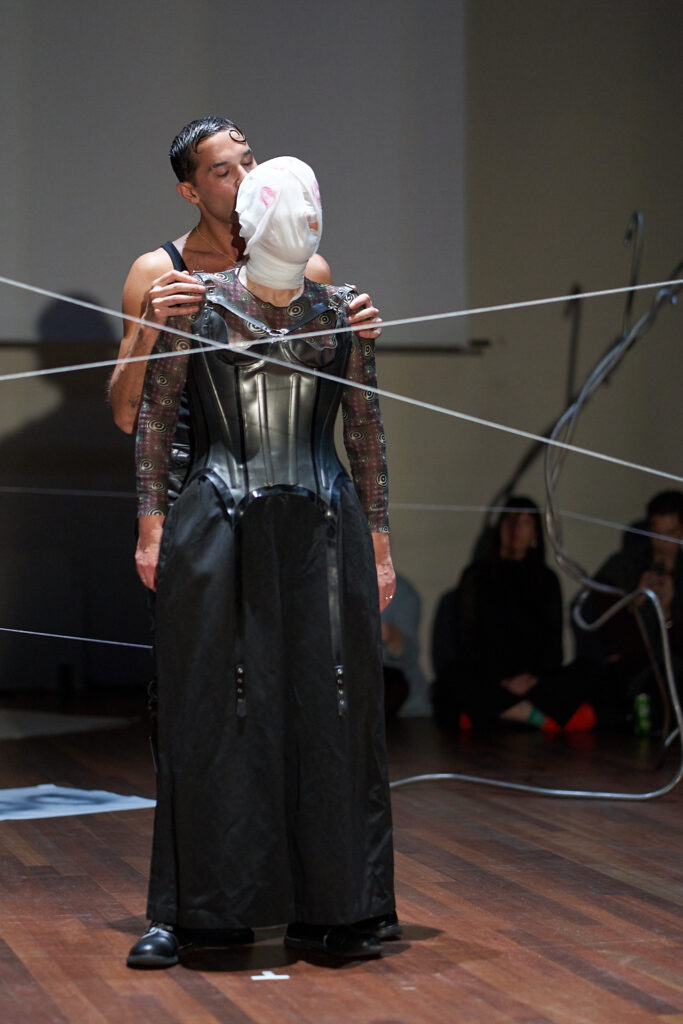


An early video work by Astrit, inspired by a socio-realistic painting of working farmers in which men and women are indistinguishable, appeared on three screens surrounding the audience. The video, Women in Construction Zone (2012), shows women endlessly striking construction site stones with pickaxes. One of the three projections then changed to Lydia’s How does it feel to be a sex object? (1978–79), in which she, chained in a corset, endlessly lashes out with a whip while her face is completely bandaged. This combination juxtaposed two works that question the body and appearance as products of political and social systems.
On stage were Astrit’s instrument sculptures, made of metal, motion sensors and coiled wires that generate sound and composition in space when moved. Astrit originally created the sculptures for the Manifesta Biennale in Pristina, the artist’s hometown, against the backdrop of long-standing restrictions on the freedom of movement of Kosovars due to visa requirements within Europe.
Unrolling and playing the wires created a web that visually resonated with Lydia’s video performance Cage (1978), in which she, as a young woman in a white jumpsuit inside a steel cage, marked her body with coloured pencils. For a brief moment, her earlier performance existed alongside her live presence. By pulling and composing with the threads, it was as if time became tangible in space, while the web formed a physical boundary that was stretched by the artists.
This exchange raised questions about imposed social and structural boundaries. Astrit and Lydia spoke with each other and with the audience about time, space, self-image, and connection. This created a continuum of historical and contemporary works, live and recorded performance. Reflecting on the collaboration with Lydia, Astrit said: ‘After 24 years of not performing, she stepped back on stage with the same fire, vision, and power. That was so moving and inspiring. I kept thinking about my grandmothers, my mother, and all the women who made it possible for us to do what we do today.’
Educational Anti-Entertainment
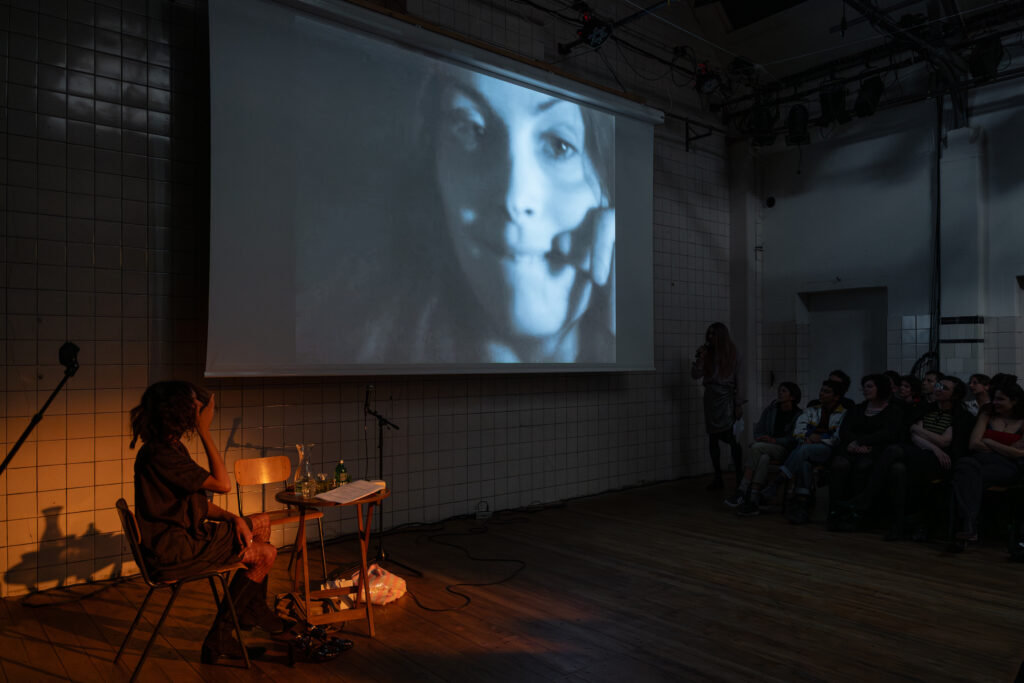
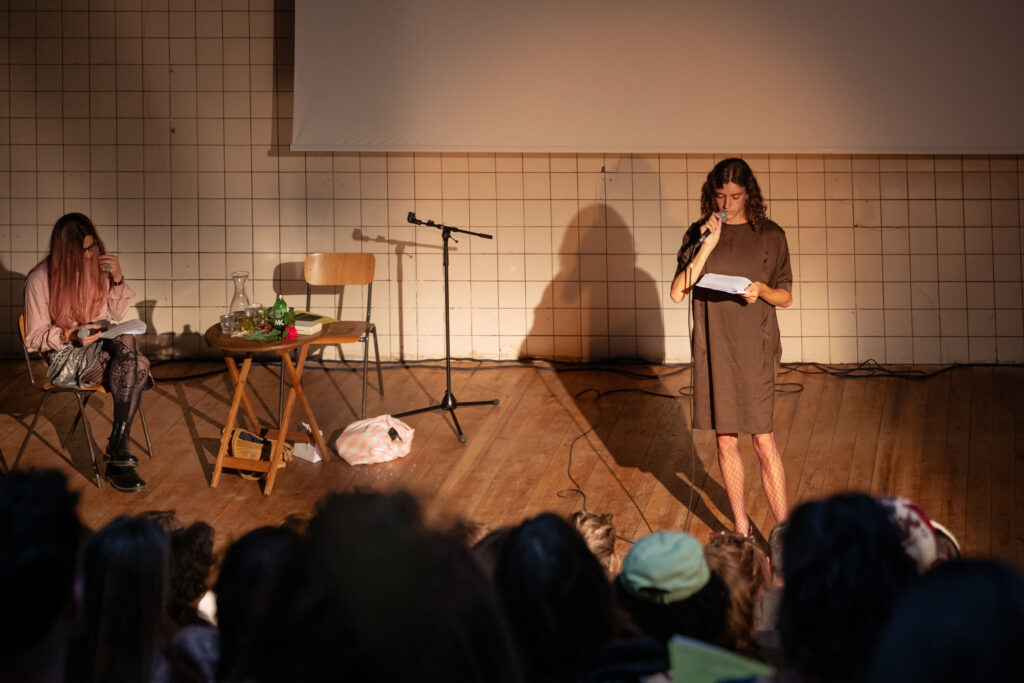
The idea that work becomes reactivated when embodied by another body, another voice and in another time was also present in an earlier Prelude evening entitled Majestic Casual –– Profumo Affair: Billy Morgan meets Sands Murray (Educational Anti-Entertainment). Whereas Lydia and Astrit engaged in dialogue through image and body, here the focus was on speech and transmission.
Sands Murray-Wassink (*1974) is an artist who constantly stretches and questions the concept of art. In his work, he emphasises the influence of feminist artists from older generations (Carolee Schneemann, Adrian Piper, Hannah Wilke) who have shaped his practice and whom he tries to “carry on”. At the same time, I noticed that Sands himself is also a role model for young artists, which prompted me to bring him into dialogue with Billy Morgan (*1994), an artist who, like Sands, works with the relationship between language and the body.
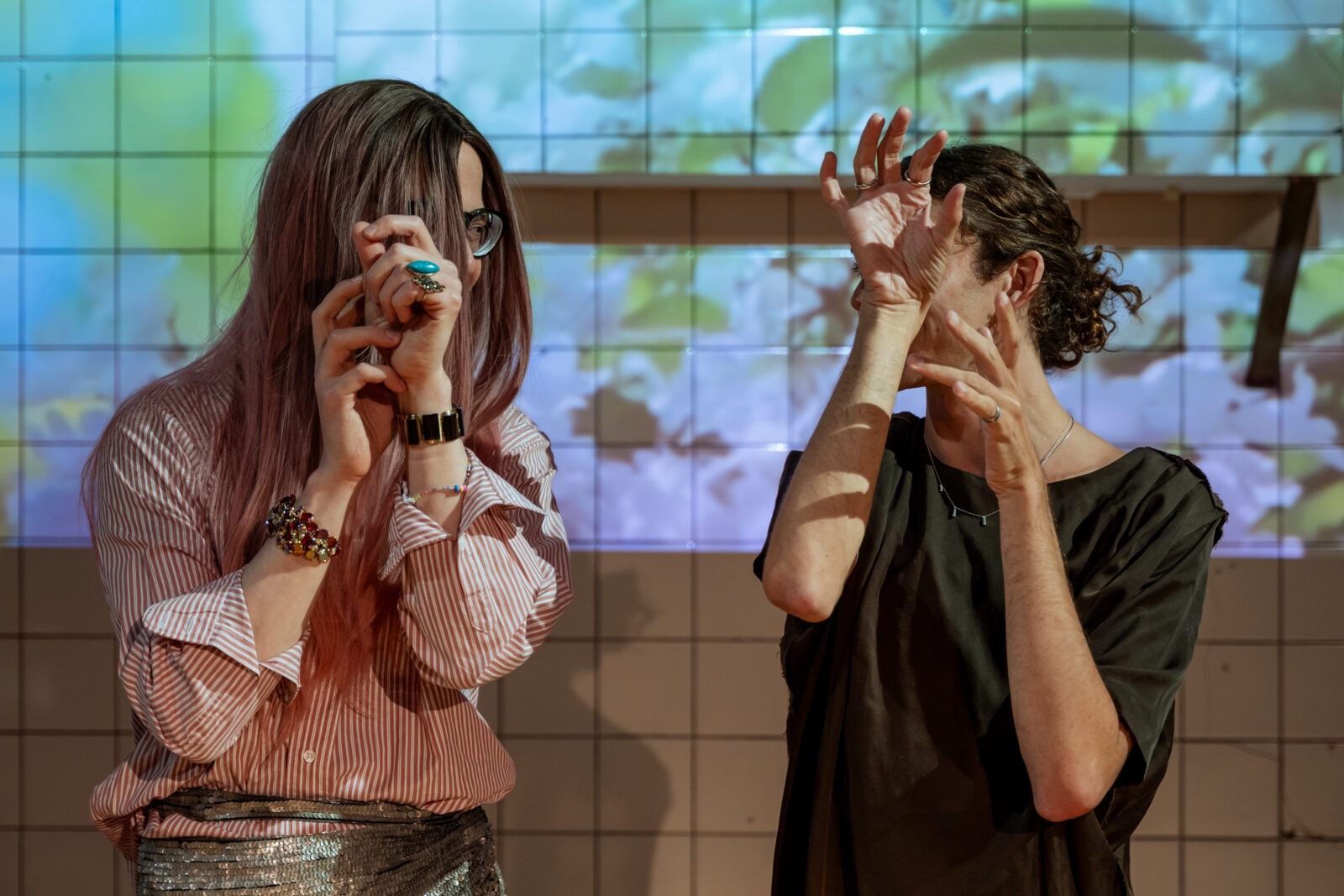
Fragments of feminist artists who influenced later generations of queer and trans artists were shown alongside work by Sands and Billy. These included Schneemann’s alternative artist portrait Imaging Her Erotics (1993) and Wilke’s Gestures (1974), in which she stares intently at the camera with subtle and expressive hand and facial movements. Meanwhile, Billy followed the gestures synchronously and Sands provided live commentary. Later that evening, the artists recited each other’s texts and embodied each other’s words. Billy took Sands by the hand to move together. This created a dynamic exchange based on Sands’ vision that “education is possible in all directions and at all stages of life”.
In relation
What makes it so important to continue supporting radical forms of art and early experiments by artists? The Prelude evenings led me to the conclusion that artists derive their knowledge and courage less from a fixed canon, and more from each other: from encounters, shared experiences, and embodying and reinterpreting work that was created in a different era.
As Griselda Pollock argues, art history is not a linear succession of masterpieces, but a network of relationships, practices and experiences that circulates across generations. From this perspective, the exchanges between Astrit Ismaili and Lydia Schouten, and between Sands Murray-Wassink and Billy Morgan take on a double meaning: they are both artistic encounters in the present and continuations of older knowledge and feminist strategies. Art history as something that is constantly being reshaped.
Remarkably, the mutual transfer and inspiration did not limit itself to one evening, but also took place between artists from different editions of Prelude. After Lydia and Astrit’s joint performance, Sands responded by email with a reflection that aptly expressed the added value of exchange and transfer: ‘The intricacy of the construction of the performance was as delicate and as strong and as natural as a spider’s web. I kept thinking of ‘relay races’, the way for the Olympics a runner runs with the eternal flame to light the way, or a baton is passed around, but this time it was in a kind of cyclical, spiral form and the power was not given or passed, but shared.’
He drew a parallel with his own practice: ‘The subject of beauty and its confusing complexity was really profound. I still think about it, because these are questions I often consider in my own work (…)’ and he reflected on what the combination of Astrit and Lydia evoked: ‘Astrit has the stage presence of a true magical rock star. That’s no secret. But on this evening, with all the parallels between the two artists, Astrit’s presence acted as both a catalyst and a counterpart to Lydia’s unique magical facets of content and form (…). The radiant, musical, erotic, glittering example of the two artists who together add good energies to the world and keep multiple things in tension at the same time, even in release. The true meaning of art.’
Artists learn from each other through dialogue, mutual transmission and reinterpretation of work. What the Prelude evenings at the Brakke Grond and Perdu, and the exhibition at the Fries Museum, have taught me is a way of understanding art history: not as a fixed line or a complete story, but as something that is constantly being rewritten in the encounter between generations. That is precisely why artists’ reflections on the work of others are not a footnote, but an essential part of how that history remains alive. Passing the fire, from one generation to the next.
More information about Prelude at www.prelude.nu
‘Louwrien Wijers – We Live in Language’ is on view until 29 March 2026, Fries Museum, Leeuwarden.
‘Urning & Urningin. Language and Desire since 1864’, featuring work by Louwrien Wijers, Philipp Gufler and Rory Pilgrim, is on view until 5 April 2026 at Nest, The Hague.
‘Manosphere – Masculinity Today’, featuring work by Sands Murray-Wassink, will be on view from 18 April to 2 August 2026 at the Stedelijk Museum, Amsterdam.
Ook adverteren op mistermotley.nl? Stuur dan een mail naar advertenties@mistermotley.nl