
‘There is no wrong way of making art, and there is not one way of being an artist’ – in conversation with Hettie Judah
‘Over the seven years that I’ve been giving talks, organizing exhibitions and events for artist-parents, this is the question I always get: how can I return to the art world? There’s no easy answer to it. I really wanted to give people the feeling that they didn’t have to wait for structural change, that they could themselves be part of creating the art world they want.’ For the series Land zonder grenzen Mirthe Berentsen talks to Hettie Judah about her book How to Enter the Art World: After a Late Start, a First Career, Illness, Raising Children, a Crisis of Confidence, Leaving It in Disgust….
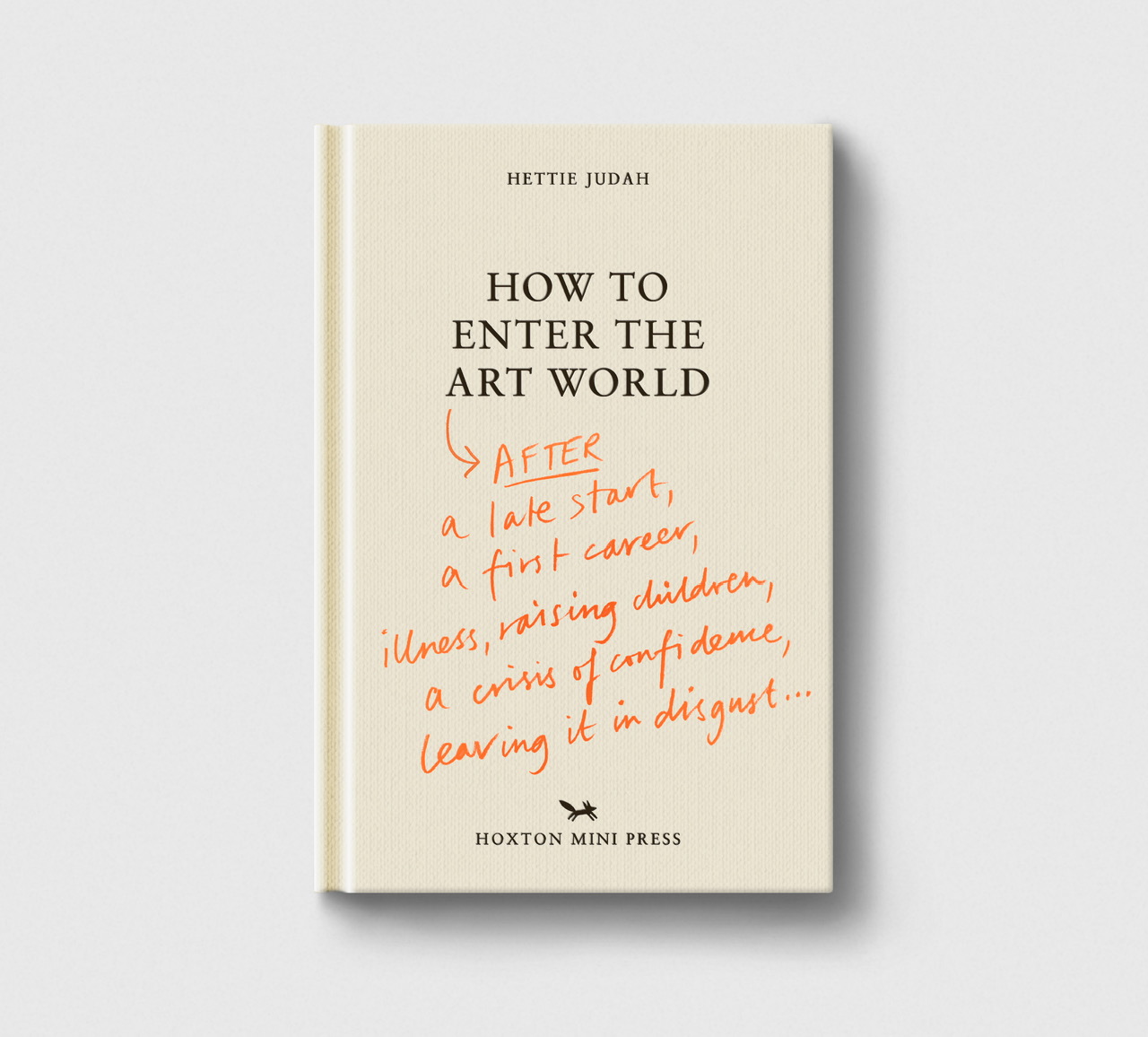
How to Enter the Art World: After a Late Start, a First Career, Illness, Raising Children, a Crisis of Confidence, Leaving It in Disgust… is the title of Hettie Judah’s new book and immediately its summary too. A practical guide for anyone who wants to return to the art world after a period of absence, which Judah herself describes as ’the final piece of a puzzle I have been working on for seven years.’
Working on that puzzle has given the British writer and curator a unique and outspoken position in the international discourse around motherhood and care within the arts. Earlier this year, the exhibition Acts of Creation: On Art and Motherhood closed, after touring England from 2024 to 2026, with works by Bobby Baker, Paulo Rego, Marlene Dumas, Tala Madani and Chantal Joffe, among others. In 2025, a book of the same title was published; the project asks not only how women have been structurally excluded from the art world, but proposes how things might be different.
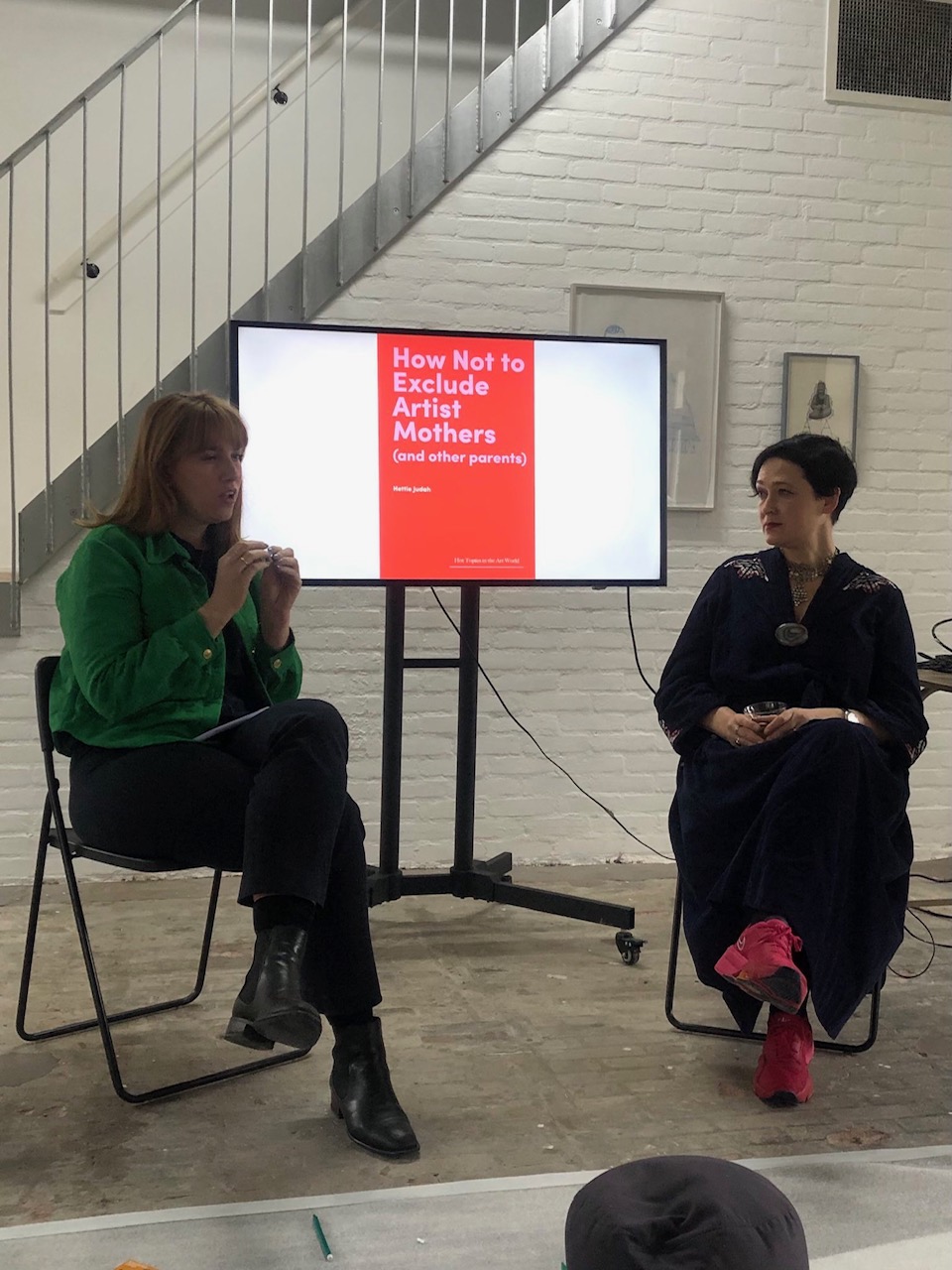
In 2022, she wrote the manifesto How Not to Exclude Artist Parents: Some Guidelines for Institutions and Residencies, which was translated into fifteen languages and put the position of artist-parents on the map worldwide. Drawing on countless interviews, the book highlights success stories and initiatives that offer practical models for the future, from alternative support networks and residency models to studio complexes with on-site childcare and galleries with explicitly family-friendly policies. I met Hettie when I translated the book into Dutch.
Mirthe Berentsen
Your earlier manifesto was directed at institutions themselves. It essentially said: you are the problem, and this is what concretely needs to change. This new book addresses the individual artist. That is a fundamentally different position. How did you arrive at it?
Hettie Judah
One of the funny things is that the earlier book, How Not to Exclude Artist Mothers and Other Parents, was intended for institutions. But 99% of the readers were artists. You simply can’t choose who your audience ends up being. Over the seven years that I’ve been giving talks, organizing exhibitions and events for artist-parents, this is the question I always get: how can I return to the art world? There’s no easy answer to it. I really wanted to give people the feeling that they didn’t have to wait for structural change, that they could themselves be part of creating the art world they want.
Understandable, but I realized while reading that there’s also a risk in that. You’re essentially writing a handbook for navigating a broken system. There’s a certain normalization in that, as if you’re teaching people to adapt rather than resist. How do you maintain that balance?
Throughout the book I’m quite frank about aspects of the system that I think are really broken. There’s a chapter on commercial galleries for example, because people always want to know how to get gallery representation. But I say right at the beginning that it’s not the right fit for everyone. I’m genuinely interested in a study into the number of people who consider themselves artists compared to the number who have commercial gallery representation. I estimate it’s something like ten per cent. And I think we really need to shift the way we think about commercial representation, because it is not a measurement of success.
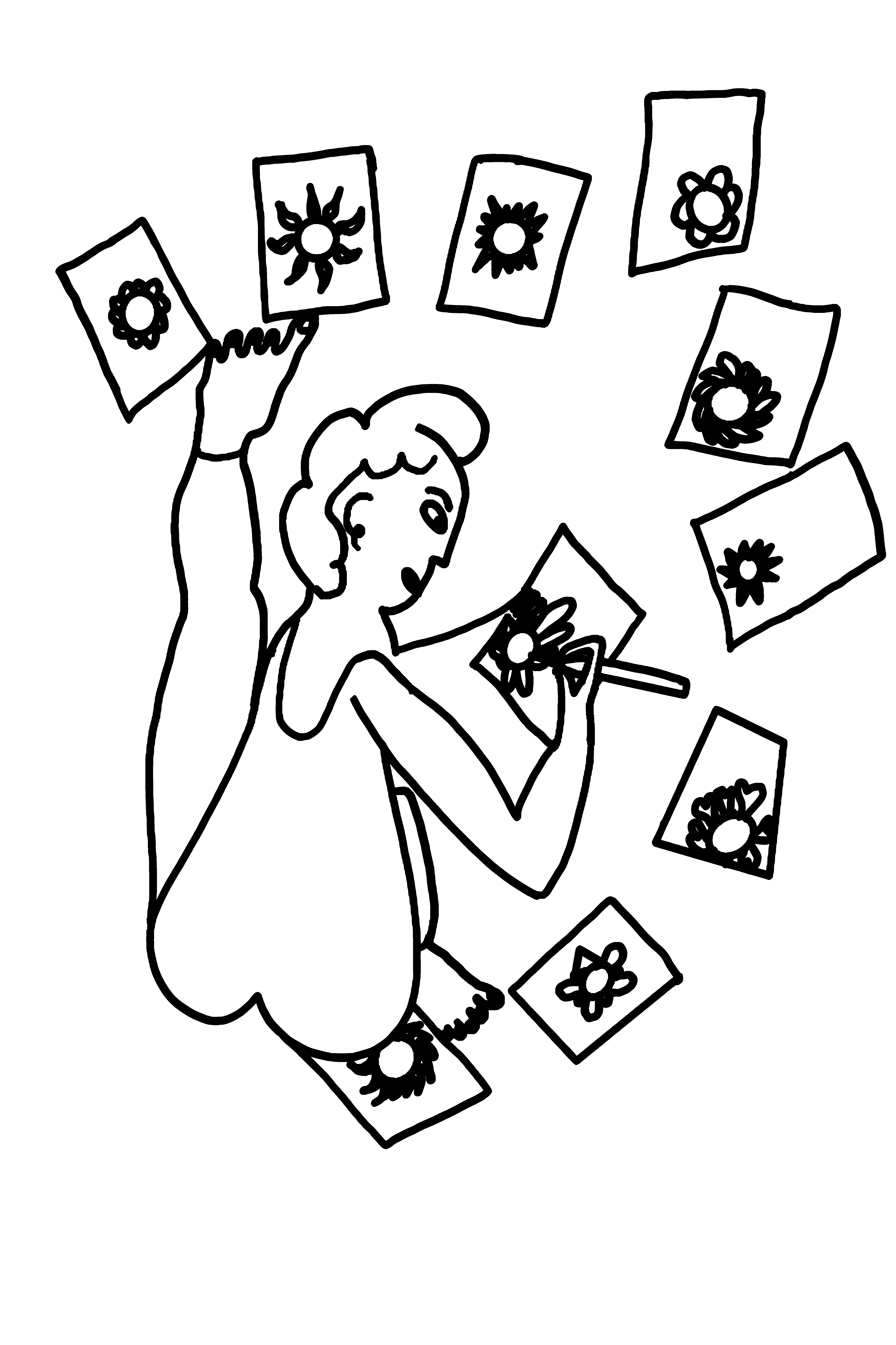
You invoke the work of British artist Bobby Baker several times in the book as an argument for a non-linear career. After the birth of her first child in 1980, Baker took an eight-year break. During that period she worked on Timed Drawings, daily drawings of life as a mother and artist, eighteen minutes a day, six sketchbooks full. But there is another interruption in her career: she was hospitalized in a psychiatric institution for several years and made the extraordinary work Box Story (2003) there, which led to a long collaboration with the Mental Health Foundation. Baker made her interruptions a substantial part of her practice, without packaging either of them as therapy.
What’s interesting about Bobby is that she’s essentially made a double re-entry. What was really interesting after her first comeback is that she had to find a completely different audience. The feminist art world was not welcoming her back with open arms, they weren’t interested in motherhood as a theme. The work she was doing around mental health wasn’t necessarily embraced by the art world either; it was more of an intersection of performance and activism. And I think there’s a lesson hidden in her life and her great success at a later age: sometimes, when you find that the structures you work within are excluding you, you need to move around them rather than keep banging against the same brick wall. When we look now at what Bobby was doing in the eighties and nineties, we regard it as incredibly important performance art. But at the time it wasn’t seen that way, she was performing in small regional theaters, completely invisible to the visual art world.
It connects to the work of feminist art historian Griselda Pollock, who writes in Vision and Difference (1988) that ‘careers shaped by care, interruption, repetition and return are framed as inconsistent or fragile rather than recognized as complex and resilient structures of practice.’ The heroic model of artistic genius, linear, singular, uninterrupted; is not a neutral description of how artists develop. It is a historical construction, built around a particular kind of body, a particular class and household, a particular kind of freedom. Exclusion from the visible structure is therefore not personal failure but structural fact.
Absolutely. Everyone should reread Pollock. What’s also very interesting in this discussion is the fact that Ireland now has a basic income for artists. That’s not only important for the artists’ work and their mental health, but simply for a livable existence. And there has been a very positive economic impact, every euro invested generated the equivalent of around €1.80 in return. So it makes sense on every level.
It also connects to a discussion happening in the Netherlands. In April 2026, nearly five hundred people from the cultural sector signed a petition initiated by Roosje Klap, director of Noorderlicht, calling for a working stipend for artists in a later phase of their practice, broadly, for people who are too old for starter grants, too experienced to be seen as ‘emerging talent,’ but still actively working. The argument: funds and institutions invest generously in beginnings, in promise and potential, but rarely in continuation, especially after interruptions and care giving responsibilities like parenthood or illness. What is your response to that?
I think it would be really, really beneficial. It acknowledges that people returning to the art world, or trying to build momentum at a certain point, really do need support. I’ve sat on prize juries where the prize went to someone whose children were already a bit older, and that recognition and financial support simply catapulted them into a whole other phase of their work. Their work improved enormously. Their self-belief grew.
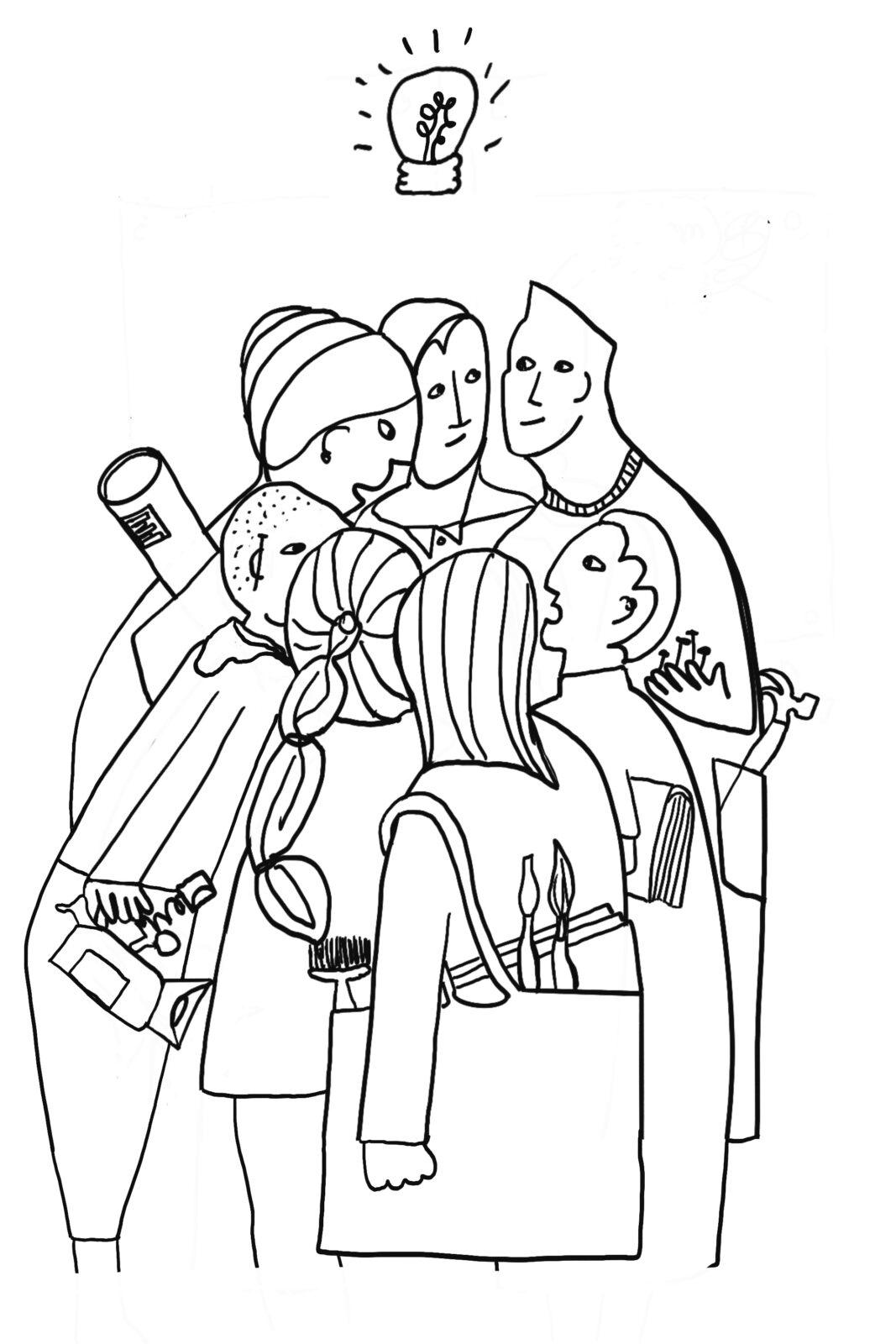
The book is divided into ten chapters, each with its own theme and its own dismantling of a myth. In chapter nine you address ‘misfits among misfits’, exploring the complicated overlap between the professional and the personal in the art world. Because so many contacts are based on personal relationships, working relationships often stem from a particular intimacy or friendship. I mean, we are a good example of that. We’ve sat together on panels and in workshops, eaten together afterwards, ended up in bars, recommended each other for things we couldn’t take on ourselves. And yet: we’re not really friends, right. I don’t know how old your children are, or when things are going badly for you.
She is quiet and lets this sit.
Ok. That puts me in my place… I do think of you as a friend.
I’m sorry. I didn’t mean to be presumptuous, and actually I do think of you as my friend. But I think it’s an interesting phenomenon and it exposes exactly what you’re pointing at in the book: there are many people in the art world I know, or feel connected to, but whom I wouldn’t call when I’m not feeling well or when I need help moving house. A kind of work-friendship.
It’s just like being at school. The art world is a place where you have to be incredibly sensitive on the one hand and have a very thick skin on the other. Most people are socially awkward. A lot of people are lonely, but the intimacy you feel is often real, while the structures that support that intimacy are not.
In part nine you describe strategies for making your needs known, including the model of the access rider, originating from the performing arts and crip community. But I find myself troubled by the equivalence drawn between access, disability and parenthood. If I think of a friend of mine who uses a wheelchair and has a child, her first question is: can I even get in there, onto the stage, to the toilet? Once that is fulfilled, there is room for another request, like childcare. Institutions often have capacity for one access need. Meaning, she has to choose which form of exclusion to bring forward. Is there a risk that conflating childcare and physical accessibility within the same framework could undermine the urgency of the latter?
I think good institutions send out an access rider to everyone as standard procedure, with all options included, that’s a way to stop people feeling guilty about requesting support or access. And access riders in relation to parenthood are also about physical access: if you’re breastfeeding, you need a space to pump, otherwise you’ll get mastitis and that affects your ability to work. So there are two levels. One is that much of the architecture of our institutions was designed without the idea that caregivers would be part of them, no spaces for breastfeeding, no ways of being there with children. The other is simply acknowledging that most people have some shit they’re carrying. Making your needs clear from the start is genuinely professional, it’s laying out the conditions under which you can function. In the UK, the accessibility budget generally sits completely separately from the production budget. I think that’s possibly how it should be.
Reading it, the book feels most of all like a conclusion, of all your work and research. The final piece of a puzzle seven years in the making. Or is there something still unfinished for you?
For me it is the conclusion and the final piece of the puzzle. It’s a book I had already been planning from the moment How Not to Exclude Artists, Mothers and Other Parents came out. There will be other things that need doing, it’s not as if the story is finished, but for me this is my last book on this subject. I have other things I want to write, and other things I have written that will come out next year, including a book on female desire. And I’m not the only one working in this field. You have clearly done very important work and continue to do very important work. Colleagues like Sascia Bailer and Diana Gravina do very important work. There will be a new generation, and then another generation after that.
It’s simply your final word on it.
It’s my last publication on it. I should say, when the manifesto first came out, the publisher said it would probably only be in print for a year, because once it was out, everything would change and we wouldn’t need it anymore. That was four years ago. It’s still selling. Things have changed, there’s more awareness, but there certainly hasn’t been an institutional revolution. I keep calling for revolution. But the revolution just doesn’t happen. What’s wrong with these people?
Maybe a next book — How to Enter the Revolution, after…
(We laugh)
I’m going to miss you! But you know what a revolution also is: the ground shifting, slowly, under the feet of the people who are still there, still making, still questioning. You will move on to other subjects, but the conversation about care and accessibility in the art world will continue, not in the least because you have built an ever-expanding network of writers, artists, organizers and curators who keep addressing this subject from multiple directions, languages and contexts.
I mean, the whole point of this book is that I genuinely believe in art. I want people to know that there is no wrong way of making art, that there is not just one way of being an artist. There exists an outdated idea that an artist should look a certain way and behave a certain way, and that’s simply not the case. There are infinite ways of being and behaving and making work. It can fit you and how you need it to be. It doesn’t need to conform to some early twentieth-century modernist cliché.
You close the book with the sentence: try not to be a total wanker. Who are you addressing?
My son works as a gallery technician and often installs exhibitions, and people don’t even say thank you. Or I work with artists who are quite casually rude, they say things like: I probably shouldn’t have been in that show, I don’t think it was the right fit for me, or I regret having offered my work at that price. This is just a really unpleasant way to interact with people. And very often we can become so self-absorbed, especially when we’re working alone in our studios and don’t interact much with other people, we really lose sight of what’s going on around us. It comes down to this: treat others the way you would want people to treat your family members.
—
Hettie Judah, How to Enter the Art World: After a Late Start, a First Career, Illness, Raising Children, a Crisis of Confidence, Leaving It in Disgust… (Hoxton Mini Press, 2026).
Ook adverteren op mistermotley.nl? Stuur dan een mail naar advertenties@mistermotley.nl