
Thinking through hands – a visit to the Wissa Wassef Art Centre in Cairo
Mirthe Berentsen visited the Wissa Wassef Art Centre in Cairo, which was founded in 1951 by architect and educator Ramses Wissa Wassef and his wife Sophie Habib Georgi. At this exceptional place, carpets are woven, among other things. Wassef rejected prevailing ideas about education and art: hierarchy, comparison, and assessment. He wanted to prove that anyone can create art, regardless of age, background, or knowledge. Mirthe spoke with Yoanna Wissa Wassef and her daughter Taya Doss, two generations who now carry the responsibility for the centre. This interview is part of Mirthe’s Land zonder Grenzen series, about the art world, care, and parenthood.
هنا
He types, simultaneously the words in my translation-app light up:
Where do you need to go anyway? It’s not a safe area here.
I want to visit the Wissa Wassef Art Centre. Do you know it?
أرغب بزيارة مركز ويسا واصف للفنون. هل تعرفه؟
His face lights up, he looks over his shoulder. Smiles, nods.
مركز رمسيس؟ بالطبع! كانت والدتي تعمل هناك، وقضيت نصف طفولتي هناك. إنه مكان ساحر.
The centre of Ramses? Of course! My mother used to work there, I spend half of my childhood there. It’s a magical place.
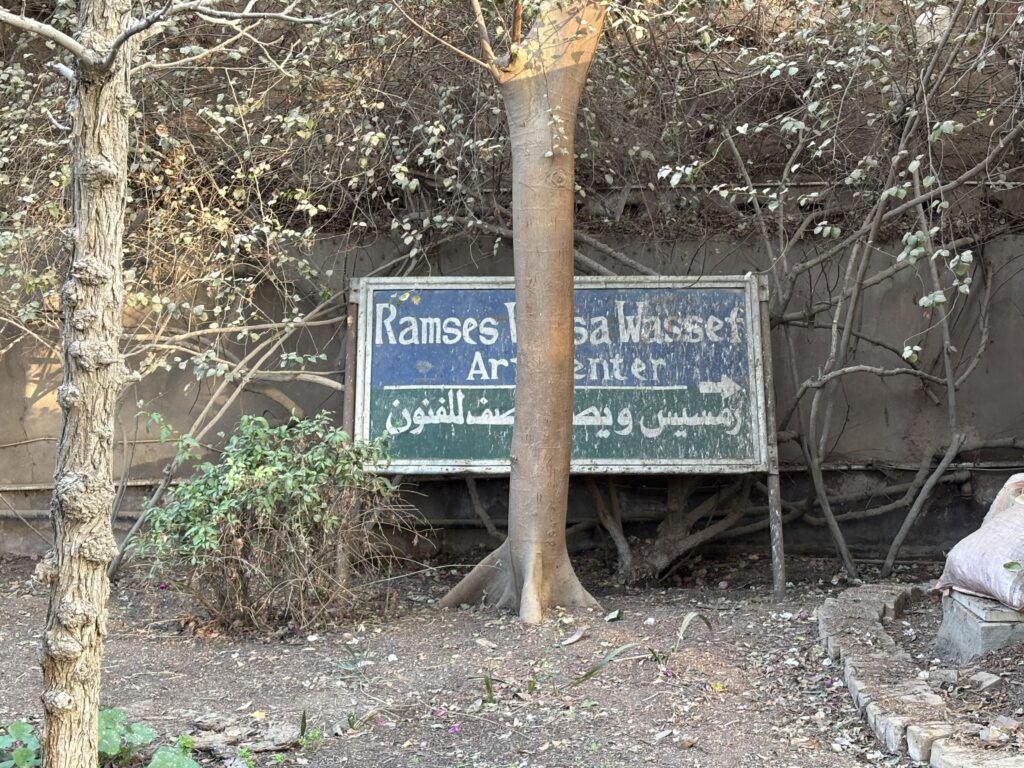
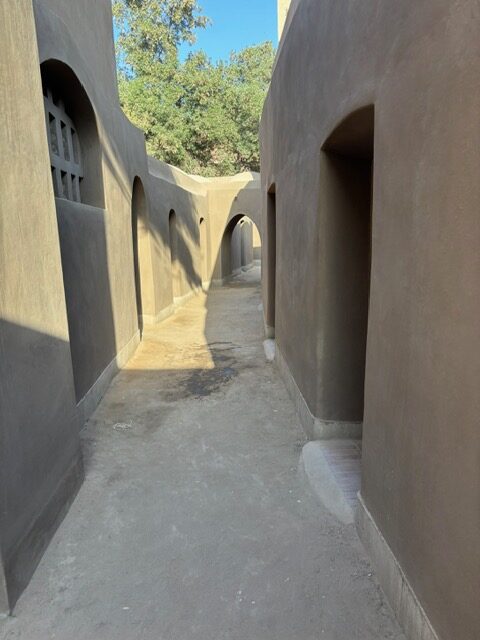
We drive through a densely built neighborhood, dusty roads, horses and mules standing in the shadow on the streets. Google Maps indicates an empty grey spot on the map, even though we drive on a street. And then all of a sudden, we take a turn, drive through the port and enter a green and lush garden and enter a different time. We’re greeted by dogs and Taya Doss, the granddaughter of Egyptian architect and educator Ramses Wissa Wassef and his wife Sophie Habib Georgi. In 1951 they started the centre, as an experimental pedagogical space in the village of Harrania, on the outskirts of Cairo. The centre is built entirely in vernacular mud-brick—domed roofs, rammed earth walls, curved corridors that seem to have grown rather than been constructed.
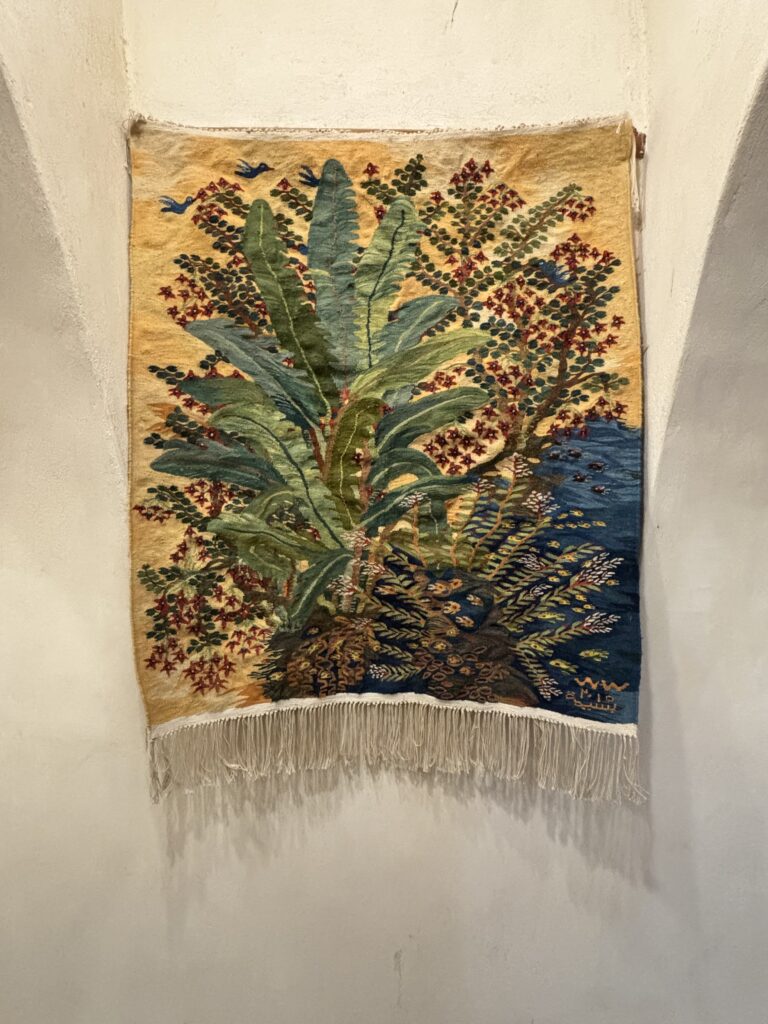
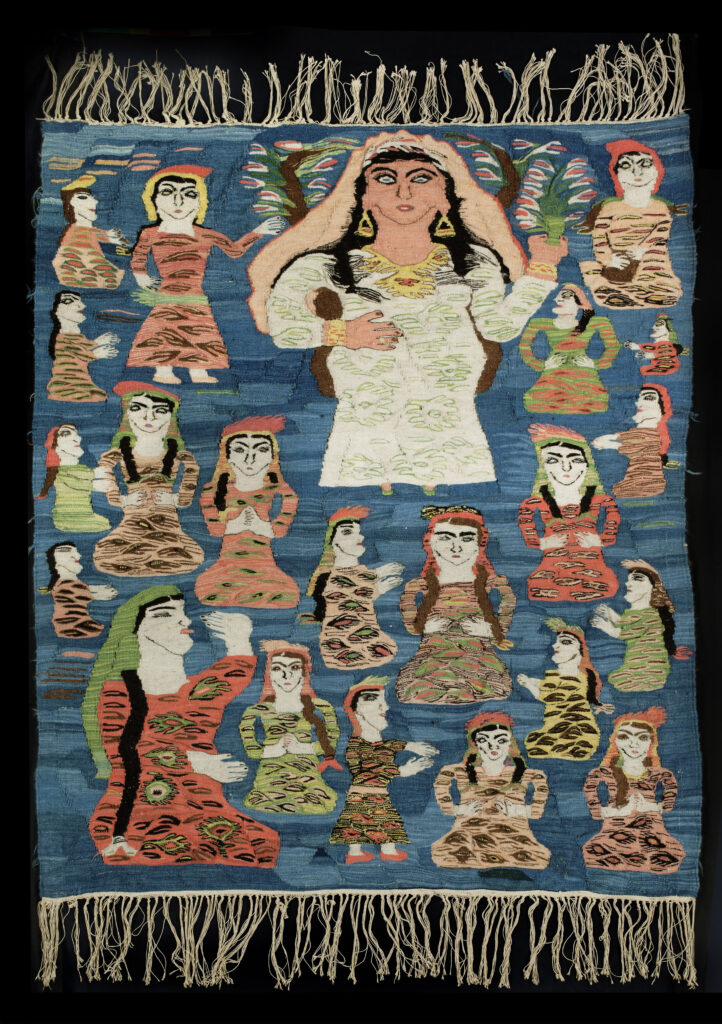
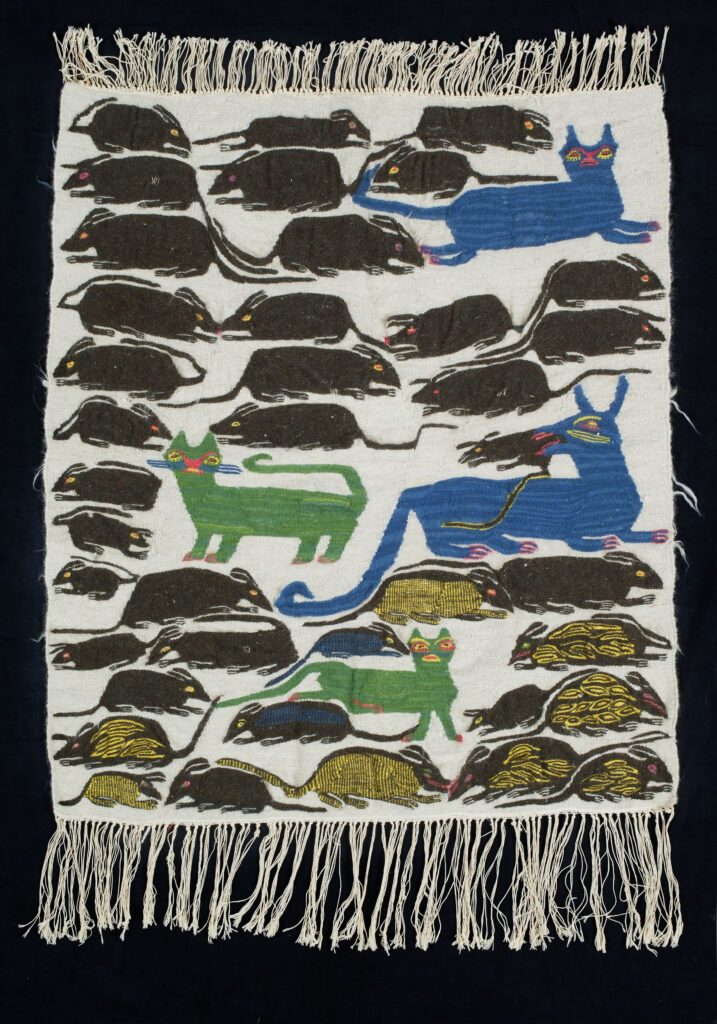
His founding vision rejected conventional systems of education and art making: rigid rules, preconceived curricula, hierarchy, comparison and judgment. Wassef wanted to prove that creativity is innate, and anyone can make art; regardless of age, background, or prior exposure to art. He did this by teaching children to weave tapestries without patterns, without instruction, without the constraints of formal training.
In 2022, I saw the exhibition “Let Textiles Talk” at the Stedelijk Museum in Amsterdam, where the tapestries made at the centre were displayed alongside work by Etel Adnan and Karel Appel, and the exploration of textile as an act and educational model for creative expression and institutional critique – moved me deeply. It resonated with my own work: questioning authorship, educational systems, children as co-makers, and play.
Four years later, I came to meet Yoanna Wissa Wassef, the daughter of Ramses Wissa Wassef and Sophie Habib Georgi, and their granddaughter Taya Doss, who now represent the newest generation taking responsibility for the centre. We talk about legacy that both gives and can be a burden.
Mirthe Berentsen
The moment I walked in it is as if you understand what is happening here: this is not a school. This is a way of living. The weavers sit in the light, behind their massive looms. Someone passes through the gently curved corridors, the sun shines through the half-moon-shaped windows, casting a patterned light on the walls, batiks and looms. I noticed I lowered my voice, slowed my pace, as if the space demands a different pace. Not just me, everyone: the weavers, artists, family members, visitors, even my rambunctious daughter. What was it like to grow up here? It is almost as if there is no competition with the loudness outside? But maybe I’m romanticizing now, ha!
Taya
Yoanna and I were both raised here, and both left to pursue another career but also came back as we were needed. Our stories are similar, yet different. My mom was traveling for a short while for health reasons, and I had to take over. This step was very important. The people here didn’t know me as a director or teacher, so this very short period showed them that I’m still one of you, that I’m here. My mom also taught me how to look at the artworks and how to write about it. Today we have a third generation of young children and weavers here, and they’re looking at me as the future. I’m learning a lot at the moment.
Mirthe
In recent years I’ve been working and writing a lot on the issue of parenthood, motherhood and combining that with artistic work as that is still deeply problematized in the western artworld. I struggle with this personally, but foremost systemically. The institutional framework that defines authorship, intellectual ownership and artistry is very exclusionary. Although I feel it is, it’s like I am learning so much from my child; creatively, but also philosophically. As I think that my own motherhood is one of the most intellectual and liberating experiences of my life. The presence of children here is so embedded in all the layers of thinking and doing of the centre. So I am very interested how you see this?
Yoanna
There are many layers to it. It’s about the educational system, the labor conditions. Our weavers have their own schedule, they decide the time and they are totally free to go and come as they please. When they have young children, they can bring them with them. They sit beside them in the room or sleep, and play with the other kids in the garden. It’s simple: the mother is more at ease when she can bring her children. She’s not worried about them. And then also when they grow older, the children are allowed to try anything they want. I mean, we all live beside one another. I mean, the kids are totally free and everybody looks after them. People work with us for years, sometimes their whole life, we really are one big family.
Mirthe
I’m now talking to two different generations. Both your (grand)parents refused the conventional school system and art system, or maybe I should say more of a Western approach of the art world. What exactly were they refusing?
Yoanna
The aim of the centre is for the child to express themselves freely from a very young age, not to be afraid to try new things or put their ideas out. We never impose an idea or say: this is wrong, this is not nice, you should do this or that. It’s their own. They can discover their own imagination and put it in a tapestry or whatever form of art. Our aim is not just to build tapestries. Any form of expression, any craft will help enlarge imagination and form personality. Children have different personalities, sometimes difficult, sometimes shy and without a voice. All these different personalities need different art forms.
Taya
Ramses didn’t even take the kids to museums because he didn’t want them to think, “I’m never going to be this good. Look at these artists.” He didn’t want an impression printed in their head as he wants theirs to come out. So we don’t tell them what to do. Sometimes we tell a story or take them in the garden and move together, enjoy the sun, the dogs, the animals, and then at the end they find their own idea. Just help them to use their eyes and their mind.
Yoanna
So we keep on telling that it’s the adults who have to change their perception of art, not the children. Because that’s our perception from accumulated viewing of other people’s work, of being taught that this is how it should be done. The other thing is Ramses hated that the art world was very prejudiced, colonial, elitist. They divided the artist and the craftsman. The artist is someone worthy of being called an artist and selling expensively, while a craftsman is just basically a tool. He thought this was destroying the art world because art has to be used in order to survive and have any meaning. And the craftsman was the original artist.
Mirthe
I think about this a lot. How in 2026, we have colonized childhood through productivity. School is chronos, measured time, standards, outcomes, power of knowledge as a single-minded transfer. With that, creativity is made into something you learn, measure, certify. We have made art something only certain people do, or afford to do, it’s leisure. What inspires me about the centre is that you say: that is not necessary. Creativity emerges when you trust it. When you provide material, time, freedom from judgment and comparison of skills or bodies. When you don’t demand that children be the same or cut to the same measure.
But I am very well aware of a romanticizing of the past in this regard.
I mean, literally (I point at the high rises surrounding the plot of lush land that we are on). How the world builds itself around you and changes from an oasis, the piece of land Ramses and Sophie bought in the middle of nowhere back then, to the neighborhood around it is completely built up. A ghetto, is what you called it earlier. Brick upon brick, stories stacked on stories, often without permits. Tall concrete towers block the sun, different shadows fall over the center. Literal and metaphorical ones. How do you deal with the changes of time?
Taya
When they started with the building, I had a choice either to feel bad about it, or we could just try to include them as much as possible. When my grandparents started, this was a small village surrounded by agricultural land, and a few families who knew each other. Now we have problems with drugs and pollution, it’s becoming more of a ghetto. We don’t know which way it will turn, so we have to take this project also outside of Harrania. Not to remove it from the children and location, but to include more people of different ages and conditions.
Yoanna
Ramses started his project with the children in Old Cairo in 1941, but the school wanted him to teach traditional designs, and copy them for profit. So eventually he had to leave and start over in Harrania with a few of the children from the school. He understood that if you want something to live, you have to let it change and you have to keep moving with it. That’s what we are doing now.
Mirthe
On the way here, I drove past the pyramids of Gizeh, past thousands of years of civilization of the highest order, past the magnificent, impressive GEM, the brand-new Grand Egyptian Museum. An architectural masterpiece that opened at the end of 2025, cost more than a billion dollars to build, and is entirely devoted to Egyptian antiquity. The pinnacle of Egyptian civilization, science, craftsmanship, art, pharaohs and knowledge, science and education, dates back to 5500 BC. So every artistic step after that is measured against an impossible greatness, against a legacy of world wonders.
Yoanna
When Ramses opened the centre in the 1950’s and chose to establish the center in a farming village, to use hand looms and natural dyes from plants grown here on site, to embrace slowness and refuse mass production, it wasn’t nostalgia, but a refusal of the colonial narrative that equated progress with industrialization and rationalization. Imagine a post-colonial Egypt struggling to honor its own heritage while also modernizing and becoming “relevant” on the world stage. I mean, Ramses proposed something radical: abandoning the very mechanism that had kept Egyptian crafts alive for centuries. The knowledge transmitted through apprenticeship, the child learning from their master. Techniques were fixed, inherited, passed down through families and guilds across generations.
Mirthe
Right, so what you’re describing, those fixed techniques, those rules, those standards, that kept the craft alive. And that’s almost the opposite of what Ramses proposed. He said: we’re not even going to a museum with the kids and the weavers so you don’t compare yourself. But nowadays, our whole economy is built on comparison, on control and management. How do you hold that legacy without losing the temperature of the present?
Taya
I think since my grandfather wanted this centre to become the education system and not just a museum, an artwork, a gallery or a community; the next step has to be that we start reaching out to people outside of the community. The good thing is that social media allows us to send out our message. Before, sometimes reporters came, taking what they wanted from our lives’ work and owning it for their purposes. Now we have a way to educate people directly without the middlemen.
Mirthe
After studying in France and seeing the so-called beaux arts, Ramses refused that legacy and instead took inspiration from folk symbolism and popular traditions to produce art that better reflected his political commitments to social reform and collective freedom. There’s a strange discrepancy in the celebration and canonization of the works in the western artworld and in Egypt. During my visit to Cairo, I talked to several gallerists and artists who had no idea about the centre or vaguely mentioned they do something with kids right?
I ask Yoanna and Taya if they think that the international appreciation, with exhibitions at the MET in New York, Musée du quai Branly in Paris, the British Museum, the Art Institute of Chicago, and the Stedelijk Museum, comes from this rejection of craft that isn’t echoing the pinnacle of Egyptian civilization?
Yoanna
Some people look at our work like it’s children’s work or outsider art, because it comes from a village and was made by people who don’t have a degree. Even if their work hangs in museums worldwide. But slowly this attitude is changing. People, and the Egyptian press, don’t make fun of the artists anymore but still they don’t show the same respect they would any artist with a diploma, especially from abroad.
Mirthe
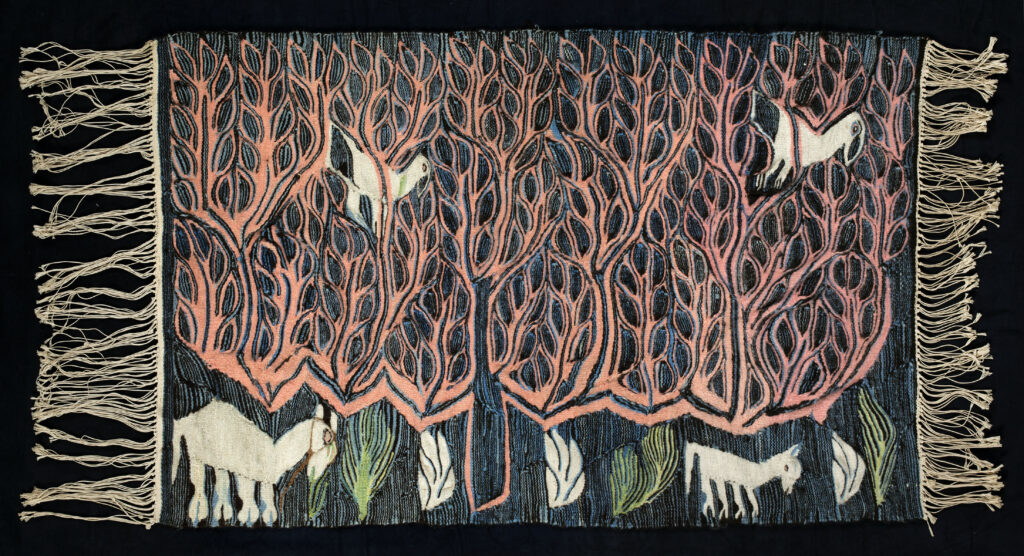
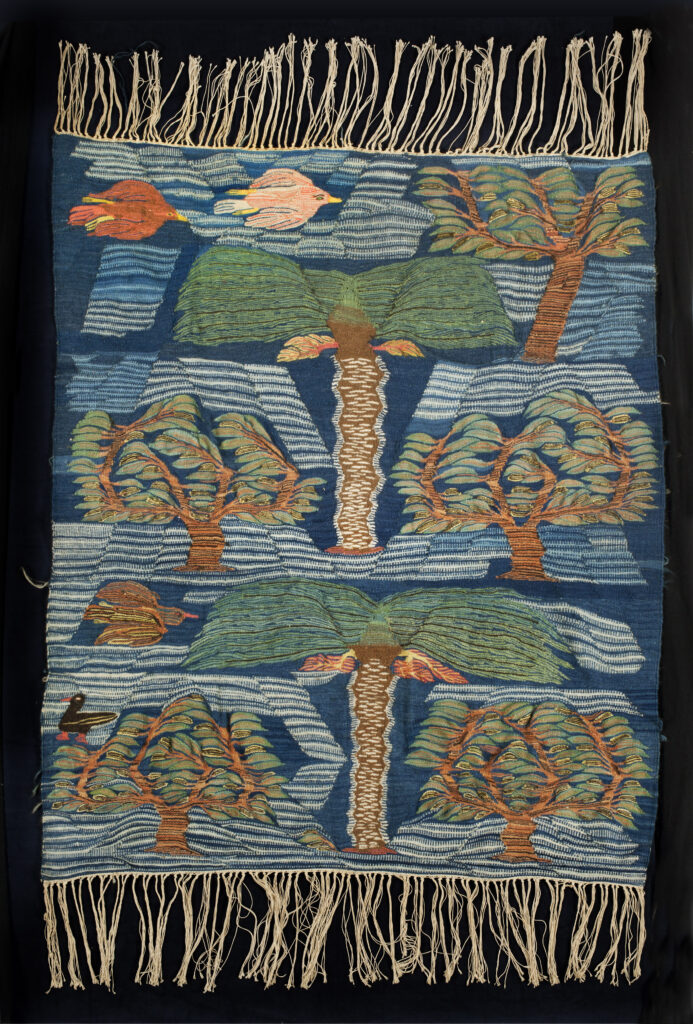
Right, so you are essentially saying that the living transmission of craft requires creative renewal. If you only teach the rules, if you say “weave like your grandmother did,” then the craft becomes an echo, preserved but dead, like the antiquity. And all your tapestries and work are still proving his point. Not imitations of ancient Egyptian textiles, or recreations of pharaonic art, no pyramids. They are contemporary work, dreamlike tales of nature, daily life and childbirth, yet they carry forward the lineage. The natural dyes, the hand looms, the patient accumulation of color and form, those ancient techniques. How do you preserve the confidence of the artist and the expression of the individual?
Yoanna
If you are allowed to express yourself freely without being judged, you can reach this stage. We say it’s the marriage of the intellect and instinct that made it work. It’s not simplifying it, by saying it’s just instinct, but the innate need to create—not just the Egyptian human, not just the farmer, just human—that intellectual force is what brought this level of artistry out. This is very important. It’s allowing talking and thinking at the same time, thinking through hands.
Mirthe
The pedagogy at the centre is that you do not teach the children how to weave using patterns or templates. Instead, you provide them with the tools and materials and encourage them to follow their instincts. I love this, but also find this very difficult as a parent, and as a teacher. For example, I have a small loom at my studio and sometimes my kid joins and I guide her through every step, as I don’t want her to f*ck up my work to be honest.
Yoanna (laughs):
Of course. But I think something very important is that they feel safe and loved and respected in their decision making. You have to be prepared to help them without imposing your own views. This is not easy. When you guide someone, you have to respect their personality and you have to repress your own ideas. I can suggest something, but I have to accept if they say, no, that’s not what I want to do. At the same time, kids are very intelligent. Sometimes they look at my face and they know if I like what they did or not. It’s not always easy, but it is for me and you to learn, not the kid.
Taya
And you must know that we teach the children the rudiments of weaving, but they have to find their own technical solutions to their problems. Like how to make a vertical line without creating holes in the weave, or weaving a circle, or putting one design in front of the other, all these are challenges that demand effort and concentration from the child, but once they achieve it, they are very proud and gain confidence in their abilities, which then again encourages them to be creative and try new designs and challenges.
Mirthe
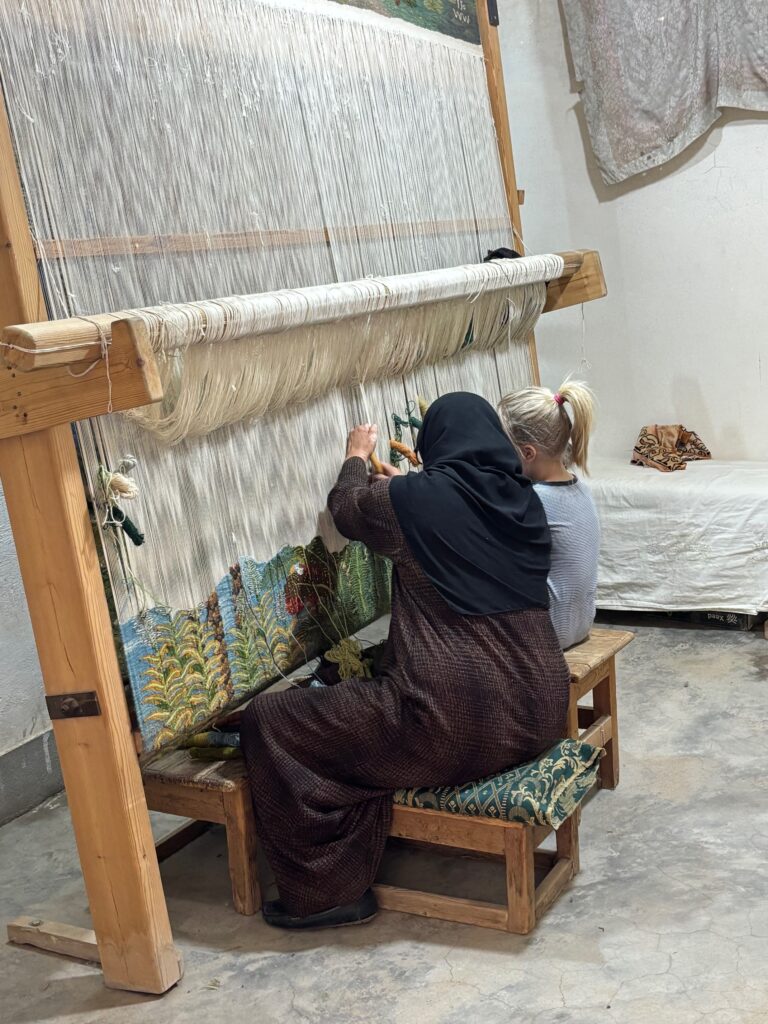
While I look at my daughter, next to weaver Soraya Hassan from behind, standing in the doorway, the enormous loom where a story of a magical garden, some animals and trees slowly unfolds, line by line, in the timespan of a year, maybe two. I realize that the highest expression and appreciation of a lived life is when each generation remakes it, not merely repeats it. Maybe that’s at the core of the centre and your work.
Taya
Agreed. It is a very important thing to understand, that we are all studying. It’s not just a school, a formal school, or a social community project, we are a family, educated in the arts.
Upcoming exhibitions
Sodertalje museum in Sweden from May 9th till October 10th 2026
Tucson Botanical Garden in Arizona, USA from September 4th, 2026 till January 4th 2027
Ook adverteren op mistermotley.nl? Stuur dan een mail naar advertenties@mistermotley.nl