
Put everything into your work, but don’t give all of yourself to everyone – on the practice of Bodil Ouédraogo
“Put everything into your work, but don’t give all of yourself to everyone.” These words of Bodil Ouédraogo form a manifesto for a generation forging its way through the demands of an attention economy that calls for total transparency, immediate legibility, and spectacular revelations—writes her sister Rita Ouédraogo. “Her refusal resonates with Glissant’s argument for opacity: the insistence that we must preserve aspects of identity and culture that resist reduction to Western models of transparency and understanding.” This essay was written in convergence with the exhibition Crossing Threads, previously shown in gelijk is ongelijk, a project space on the former island of Marken.
What does it mean to inherit not answers but questions? To receive from those who came before not certainty, but the capacity to hold complexity? Artist Bodil Ouédraogo’s work unfolds as a sustained meditation on inheritance as a living, relational practice. One that refuses the false promise of transparency while insisting on the generative potential of what Édouard Glissant termed opacité: the right to remain partially veiled, not fully understood, grasped, or reduced.
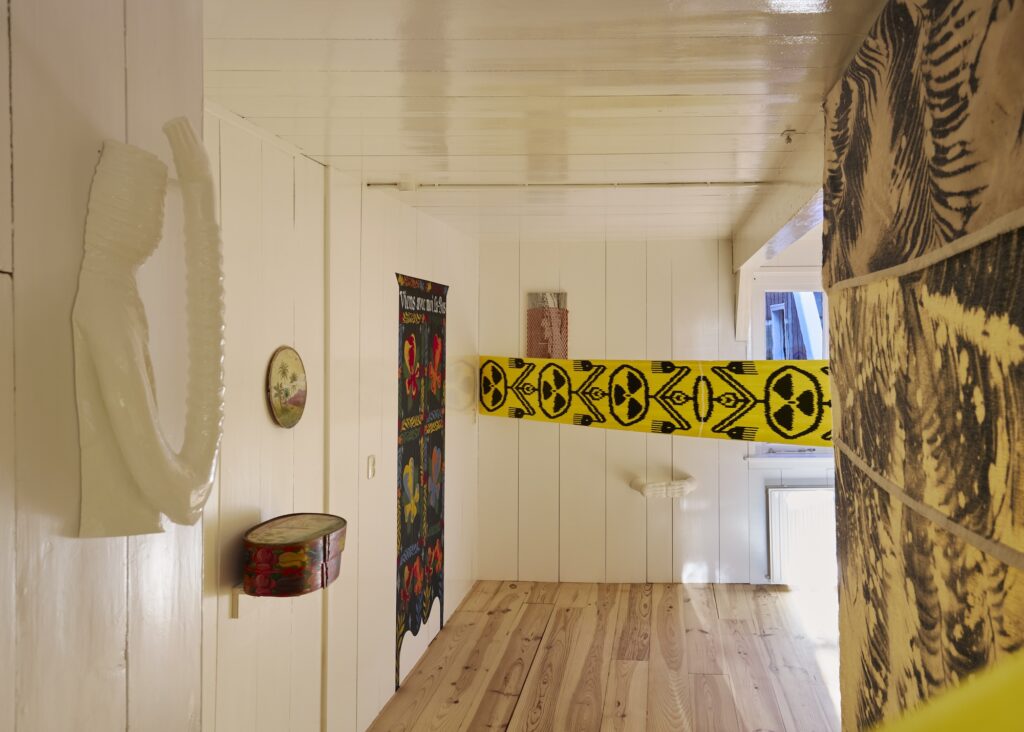
Working at the intersection of textile traditions, sculptural memory, and diasporic transformation, Bodil creates installations that overflow their boundaries, where works layer, echo, and interact anew, each piece reinforcing and complicating the others. Her approach embodies what Glissant called donner-avec–giving-with–a mode of relation that embraces uncertainty rather than demanding immediate legibility. In an era that insists on instant comprehension and spectacular gestures, Bodil offers something more radical: spaces of gentle destabilization, where meaning accumulates slowly and collectively, through engagement rather than extraction.
WEAVING THROUGH GENERATIONS
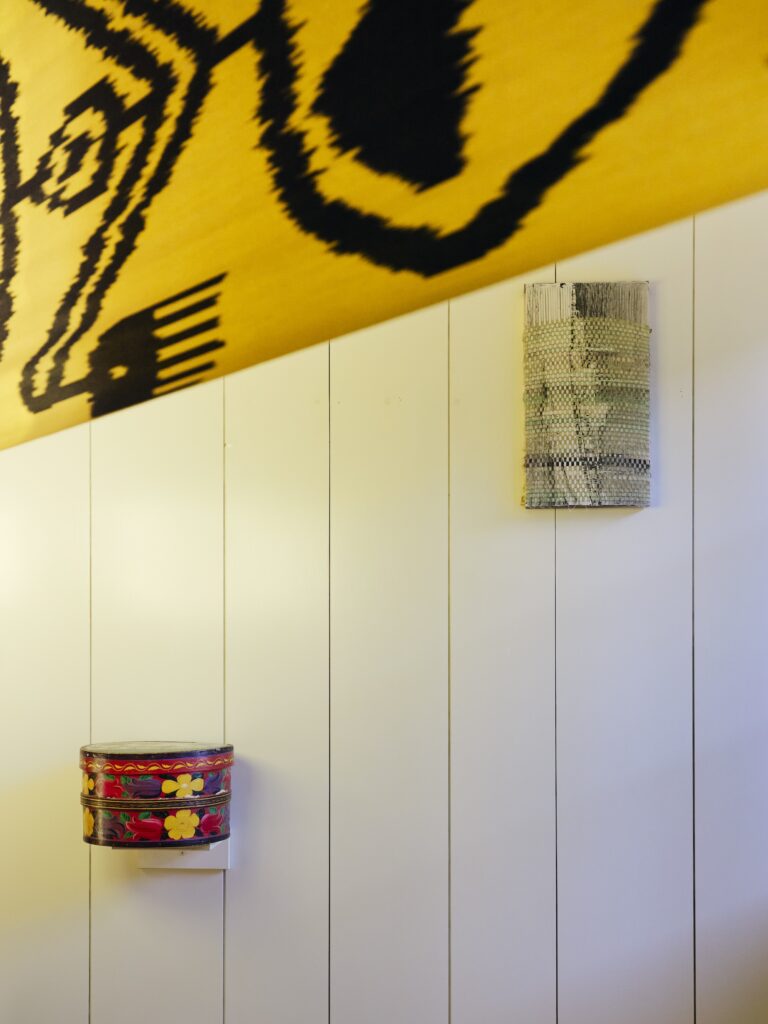
At the heart of her practice lies a question that extends beyond the personal into the structural: does the individual even exist? Or is what we call “self” always already constituted through collectivity, through the accumulated gestures of those who came before? Her work with bazin riche, that stiff, gleaming damask fabric central to West African ceremonial dress, becomes a material investigation into how identity moves across bodies, generations, and geographies. The grand boubou, with its abundant folds and spatial claims, reveals the rich folds bazin riche is capable of–a bundling of material that signals not only individual wealth but collective accumulation, care transmitted across time. When she translates this fabric’s visual vocabulary into contemporary forms, collaborating with fashion brand Patta to transform ceremonial opulence into streetwear vernacular, she is not simply updating tradition. She is asking: what happens when West African modes of dressing-up enter into dialogue with Amsterdam’s (urban) codes? How do these practices of self-making evolve while retaining their capacity to signify belonging? This is inheritance understood not as static transmission but as active circulation and reinterpretation. The bazin riche moves between Ouagadougou and Amsterdam, between ceremonial past and contemporary present, accumulating new meanings without discarding old ones. Like Glissant’s conception of identity as relation rather than root, the fabric refuses linear temporality–it lives in simultaneity, folded across moments, bodies, and worlds.
THE SCULPTURAL MEMORY OF BODIES
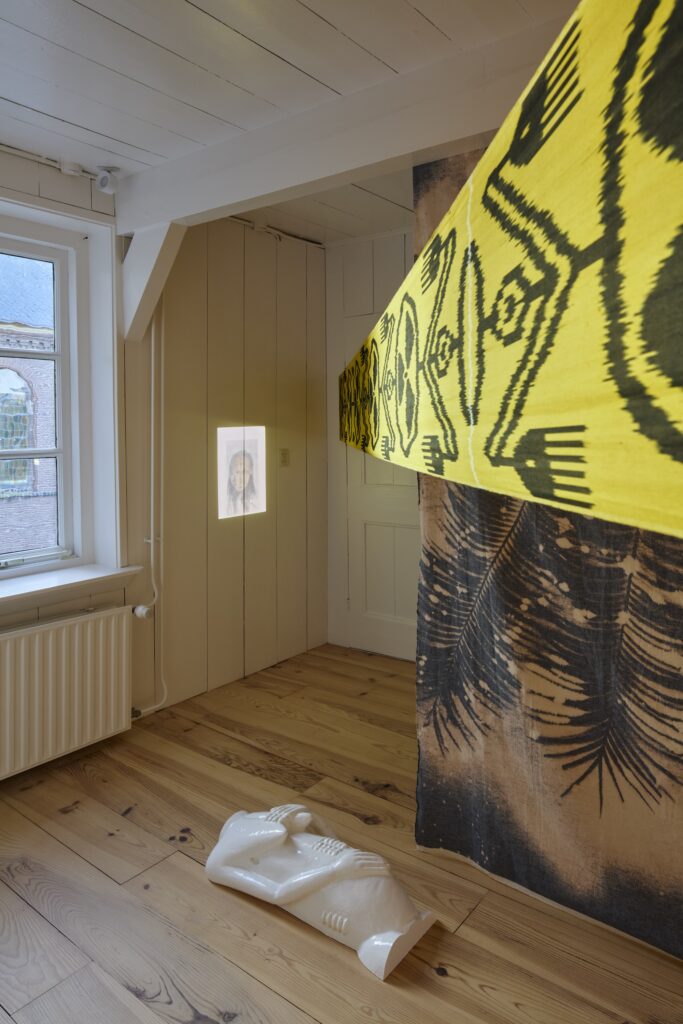
In Framed Intimacy 01, Bodil extends this inquiry into sculptural form, treating West African wooden sculptures not as frozen relics but as kin–active participants in contemporary becoming. She “unfreezes” these forms, interacting with their ways of posing, bearing, and positioning. The work suggests that identity resides not only in what we wear, but in the body’s memory of ancestral forms: gestures that precede us, postures we inherit without conscious choice.
Framed Intimacy 01 reimagines sculptures from our father Mamadou Ouédraogo’s personal collection, pieces of our heritage. Through them, we glimpse how those before us sculpted presence, how they imagined the body in form and spirit. Bodil asks: what we can learn from these bodies and their poses? When she portrays them in ID photo format–sublimation prints on fabric where portraits of people are layered on top of prints of the faces of wooden sculptures–this deliberate framing interrogates recognition and dignity. What does it mean to possess an ID photo? How does this bureaucratic marker confer–or deny–recognition, personhood, even humanity? The layering of human portraits with sculptural forms on fabric creates a material overlay where boundaries blur: flesh and wood, living and ancestral, the documented citizen and the museum object share the same surface.
By placing sculptures in the passport photo format rather than on pedestals, Bodil challenges hierarchies that elevate human as well as object. She reimagines what can occupy the frame of the recognizable subject, while the sublimation process itself– where pigment fuses into the fibers rather than resting on top–suggests a deeper kind of integration: a becoming-through-relation that the medium itself enacts. The stacking and layering in her work mirror the bundled folds of bazin riche: both are practices of accumulation that refuse isolation in favor of collective presence. This is where her personal inheritance becomes methodology. The bond we share as sisters, our relationship to our father, to ancestors whose specific features may blur yet whose presence remains palpable. These are not biographical details or anecdotal traces but rather structural principles. They model a way of being that understands identity as fundamentally relational, as a choreography of connection rather than a performance of autonomy.
OPACITY AS OFFERING
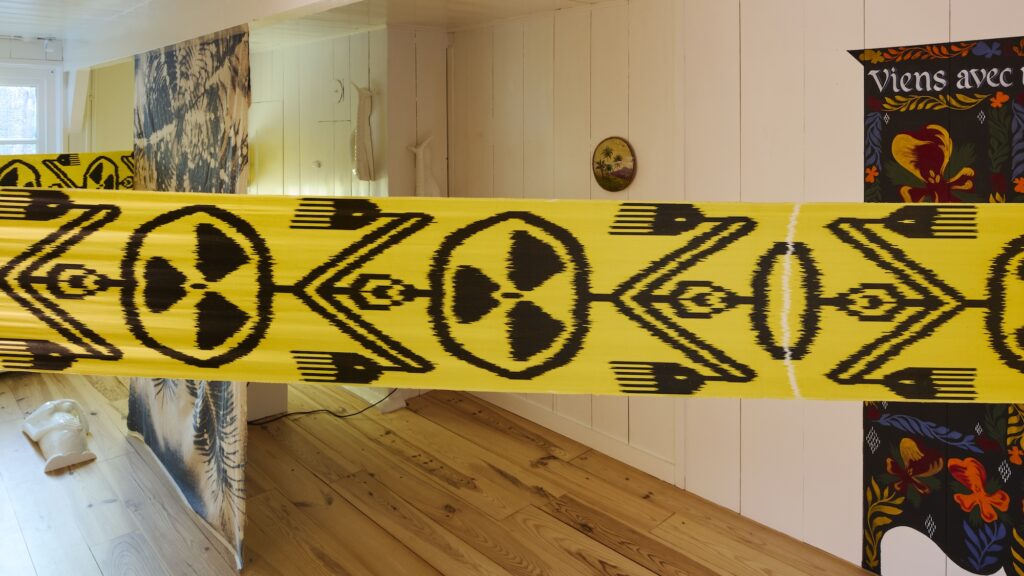
“Geef alles in je werk maar geef niet alles aan iedereen”—give everything to your work, but don’t give everything to everyone. Bodil’s words form a manifesto for a generation navigating the pressures of an attention economy that demands total transparency, immediate legibility, spectacular self-disclosure. Her refusal resonates with Glissant’s argument for opacity: the insistence that we must preserve aspects of identity and culture that resist reduction to Western models of transparency and understanding. Opacity here is not withholding, but a form of protection, a way to honor complex aspects of identity without surrendering them to forces that seek to capture, categorize, and contain. Opacity not as concealment, but quite the opposite, as generosity. By refusing to overexplain, by creating works that exist simultaneously in the futuristic and nostalgic, Bodil opens space for viewers to bring their own complexities, their own questions. Her installations create something to be both looked at and experienced: a “concentrated motion” that invites questioning of how we perceive people and objects, allowing new realities and hierarchies to emerge. In this sense, her practice offers an antidote to the spectacular gesture: rather than demanding immediate comprehension or emotional catharsis, she cultivates spaces of gentle instability.
The works overflow and reinteract with each other, all layering, all eclectic, refusing singular narratives. Like the bundled folds of bazin riche or the stacked compositions of her ongoing research ID Portraits, meaning thickens through relation. Through inheritance.
BREATHING NEW WORLDS
What Bodil ultimately offers is a way to imagine new worlds—not through the fiction of starting from nothing, not through the violence of rupture, but through donner-avec, through giving-with. This is inheritance as active practice, one that asks: how might we live our most truthful complexity together, rather than apart? The answer, her work suggests, emerges through recognition of the many connections, relations, and links that go back and beyond. Each gesture of dressing, each posture remembered from wood, becomes possible only through the invisible web of relations that precede and exceed every single body. There is no isolated self; there are only individual questions and personal struggles that link to bigger systems, and bring up conversations that awaken ancestral memory. This is not nostalgia for a pure past, nor a utopian flight into an imagined future. It is the recognition that we have always been plural, always in relation, always breathing through networks of connection we did not choose, yet constitute us nonetheless. Bodil’s work does not seek to resolve this complexity—it honors and celebrates it. In doing so, she creates spaces where we might rehearse living otherwise: together, layered, opaque—and in that very opacity, radically free.
gelijk is ongelijk is a project space on the former island of Marken. The name refers to a carpenter’s saying about “working wood”—which continuously changes under the influence of time and environment. This idea of change forms the conceptual framework for a program in which material culture, shifting meanings, and historical continuities take center stage. The projects connect contemporary art practices with local histories and explore how images, stories, and objects continue to circulate and transform.
The publication Crossing Threads emerges from the exhibition of the same name (14 November 2025–17 January 2026), featuring art works by FreelingWaters, Dilyara Kaipova, Nazif Lopulissa, Jan Moenis, and Bodil Ouédraogo. The exhibition and publication, with texts by Piet Korstman, Rita Ouédraogo, Amanda Pinatih, and Robbie Schweiger, reflect—through specific elements of Marker heritage—on broader questions of coloniality and representation. In doing so, they reveal how histories unfold, persist, and are continually reinterpreted. Heritage thus appears not as something fixed, but as a dynamic field of meanings that is constantly being renegotiated.
Following the move of founder and curator Robbie Schweiger to Marken, gelijk is ongelijk opened at the end of 2023 as a home-based project space. Since 14 February, the space has been open to visitors at its new location at Kruisbaakweg 5B on Marken. More information can be found on their website: Home — Gelijk Is Ongelijk
Ook adverteren op mistermotley.nl? Stuur dan een mail naar advertenties@mistermotley.nl