
The belly as a transformative space – on The Belly of Momo in Buro Stedelijk
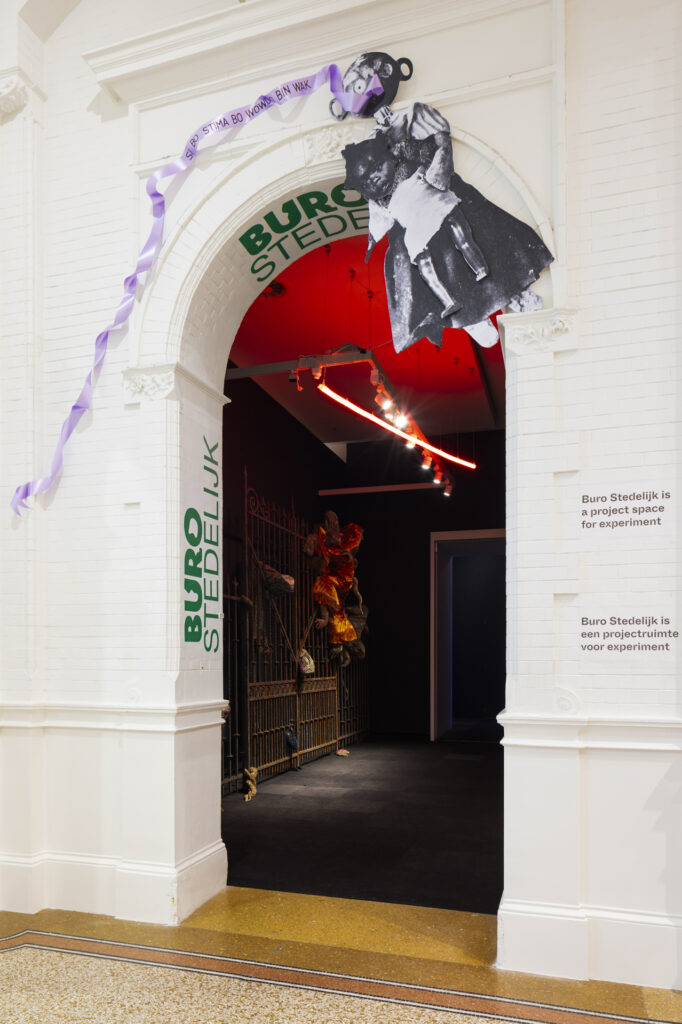
Met The Belly of Momo neemt curator Rita Ouédraogo afscheid van Buro Stedelijk, de plek voor experiment in het Stedelijk Museum Amsterdam. In dit essay reflecteert ze op de installatie van Kevin Osepa. ‘Voor Kevin Osepa is the Belly of Momo zowel onderwerp als strategie. Een poreuze filosofie die een spiegel vormt van Buro Stedelijk zelf. Beide zijn interieurs in wording: plekken om samen te komen, om te experimenteren, waar chaos gekoesterd mag worden. De (onder)buik kan tegengestelde krachten dragen zonder oplossingen te behoeven: rouw en vreugde bestaan naast elkaar en dragen beiden de resonantie van onze voorouders.’
‘Si bo stima bo wowonan, no bin wak’
The puppet king dies every year and every year, he rises again. In Curaçao’s Karnaval, King Momo, a corpulent figure of collective catharsis, embodies a cyclical truth: temporary structures recur, endings contain future beginnings. Death is not terminus but a transition, and ancestors remain active participants.
Past and present interpenetrate; the spirit persists, breathing new form into next year’s incarnation. But here we linger less in Karnaval’s streets but within its interior pulse, in the belly itself.
Within the Central Space
The Belly of Momo unfolds in Buro Stedelijk’s Central Space, a location that has itself become a kind of belly. A generative hollow where experimental practices and communal gathering have taken root. This show marks a significant threshold: it is the final project I curate at Buro Stedelijk, a space that has served as both laboratory and sanctuary for artistic experimentation. Like the cyclical nature of King Momo himself, this ending contains within it the seeds of future beginnings, a transition rather than a closure.
The Central Space has long operated as a site of becoming, a place where institutional frameworks soften to accommodate practices that resist easy categorization. A space that can hold contradiction, opacity, and transformation without demanding resolution.
For Kevin Osepa, the Belly of Momo is not only subject but rather strategy. It grants temporary freedom across multiple time-spaces, a porous philosophy of practice that mirrors Buro Stedelijk itself. Both are interiors of becoming: places for showing up together, experimentation, and holding chaos as sacred. The belly holds contradictions without demanding resolutions: mourning and joy coexist, and carries the resonance of ancestors and their vibrations. Here, the many collaborations that make meaning are held, layered, and woven into being. It is a space where opposing forces need not resolve but can dwell together: where scale collapses, intimate archives transform into explosive color and deep darkness, where whispered histories flare into noisy bodies.
Entering the Belly
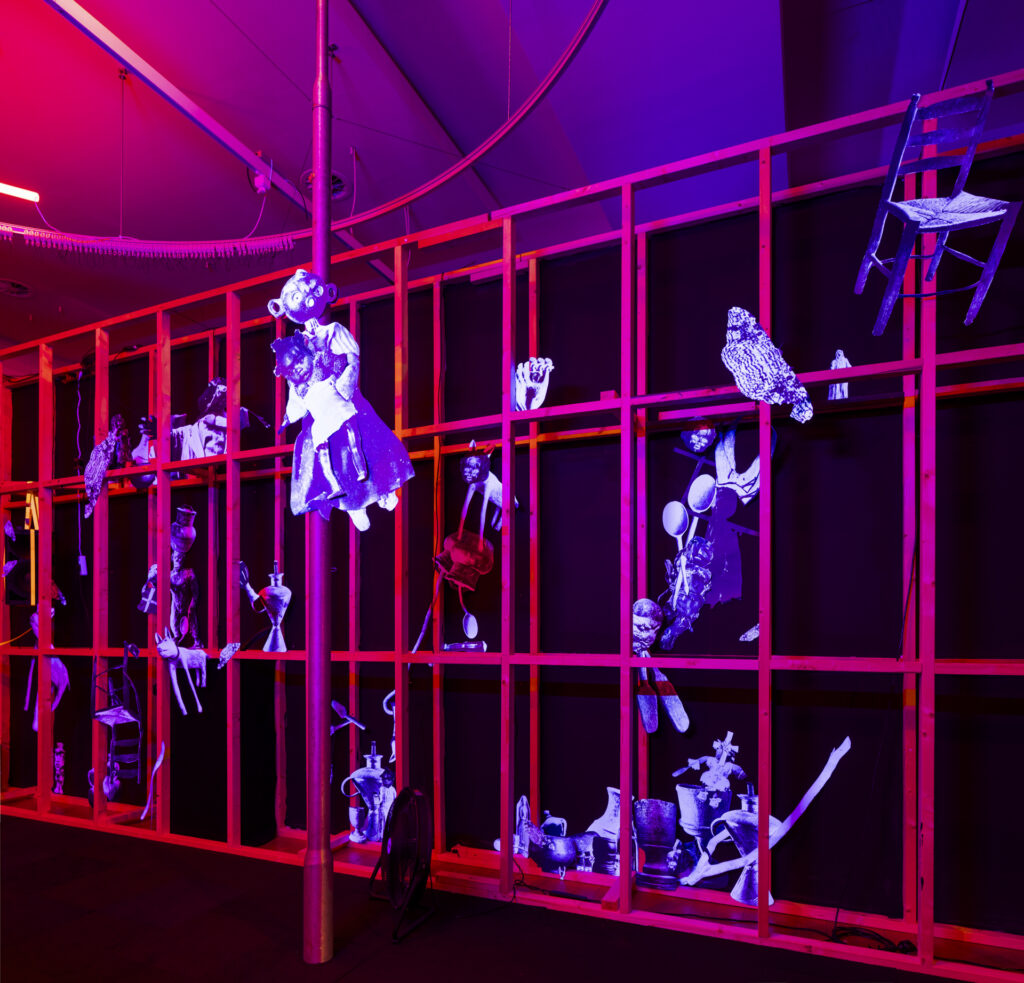
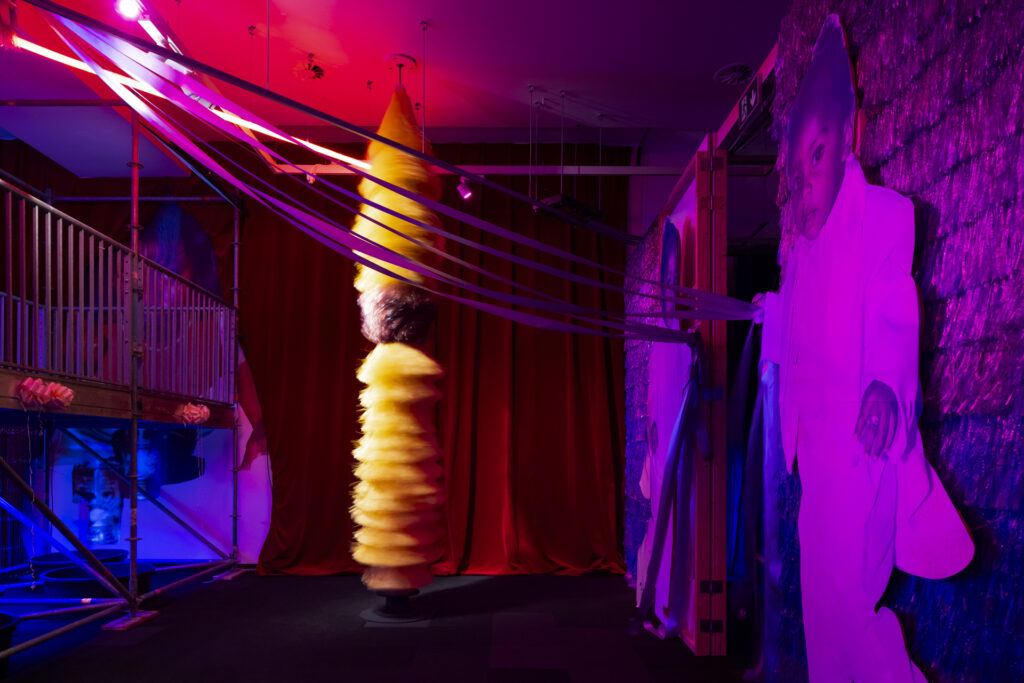
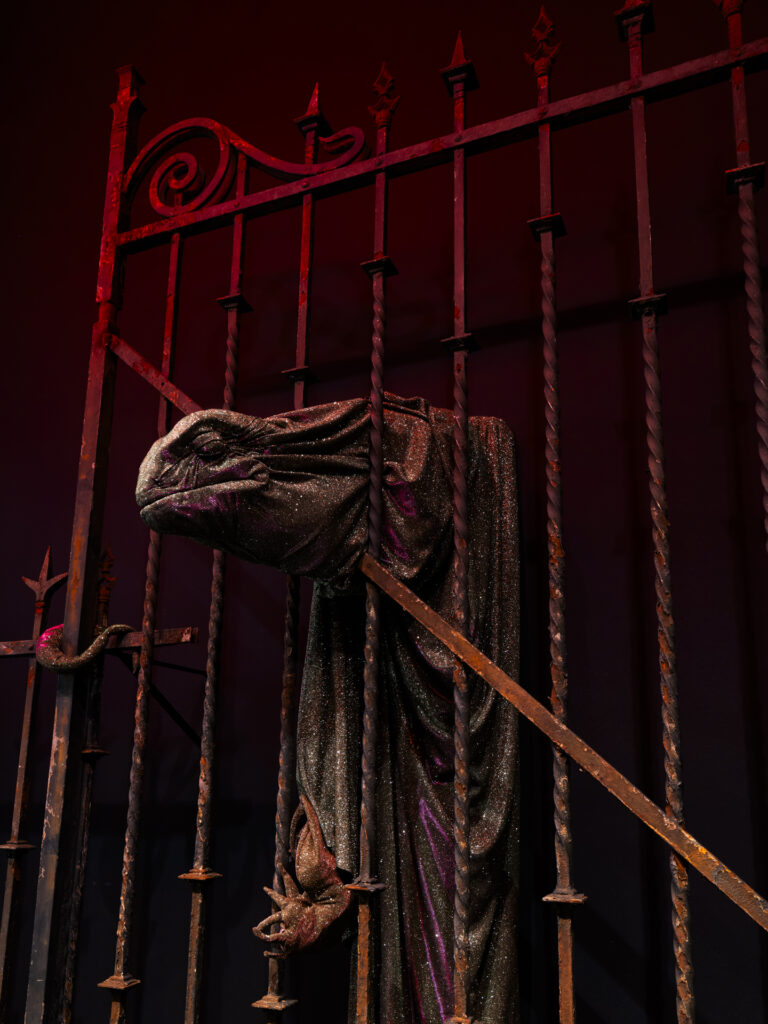
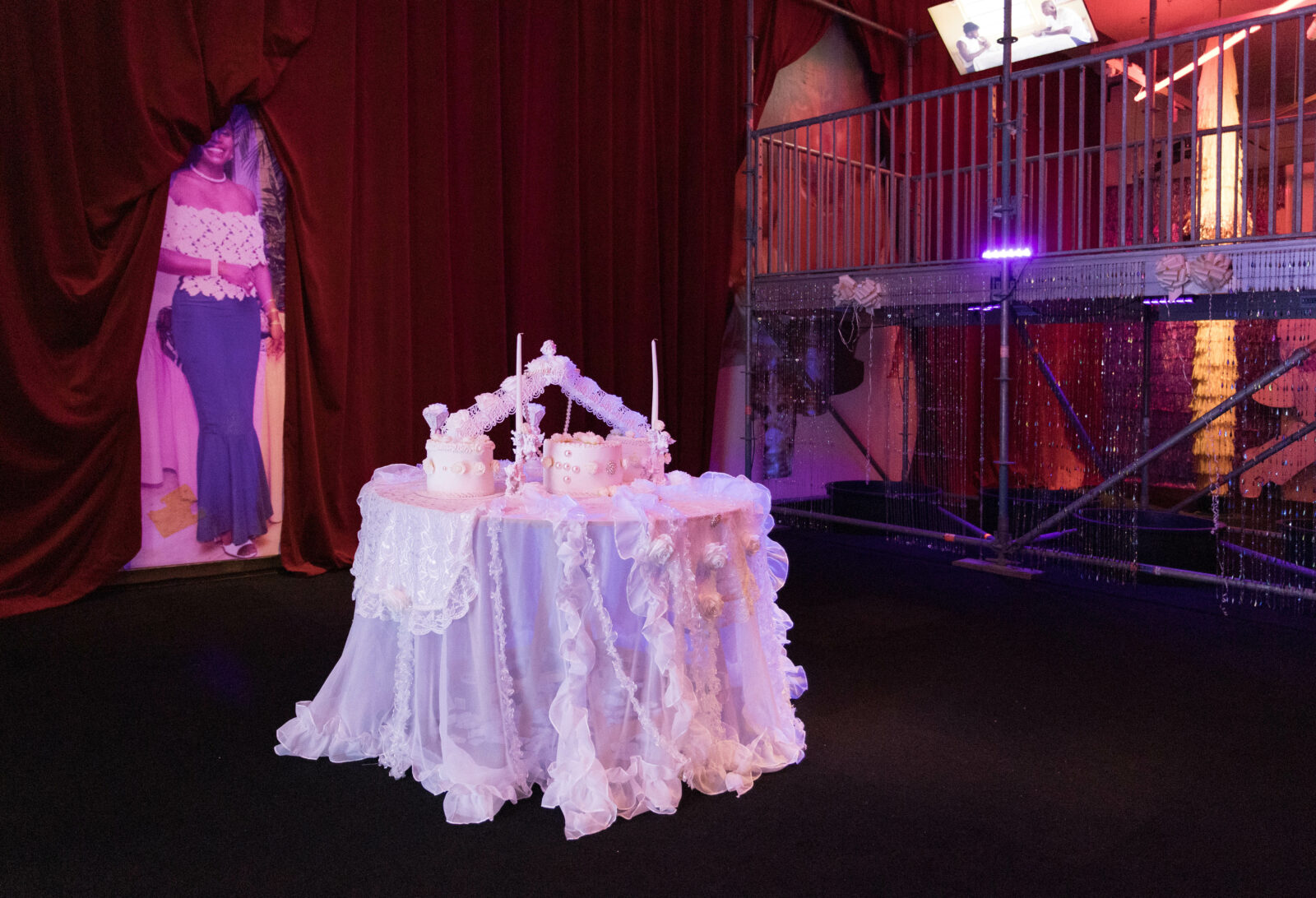
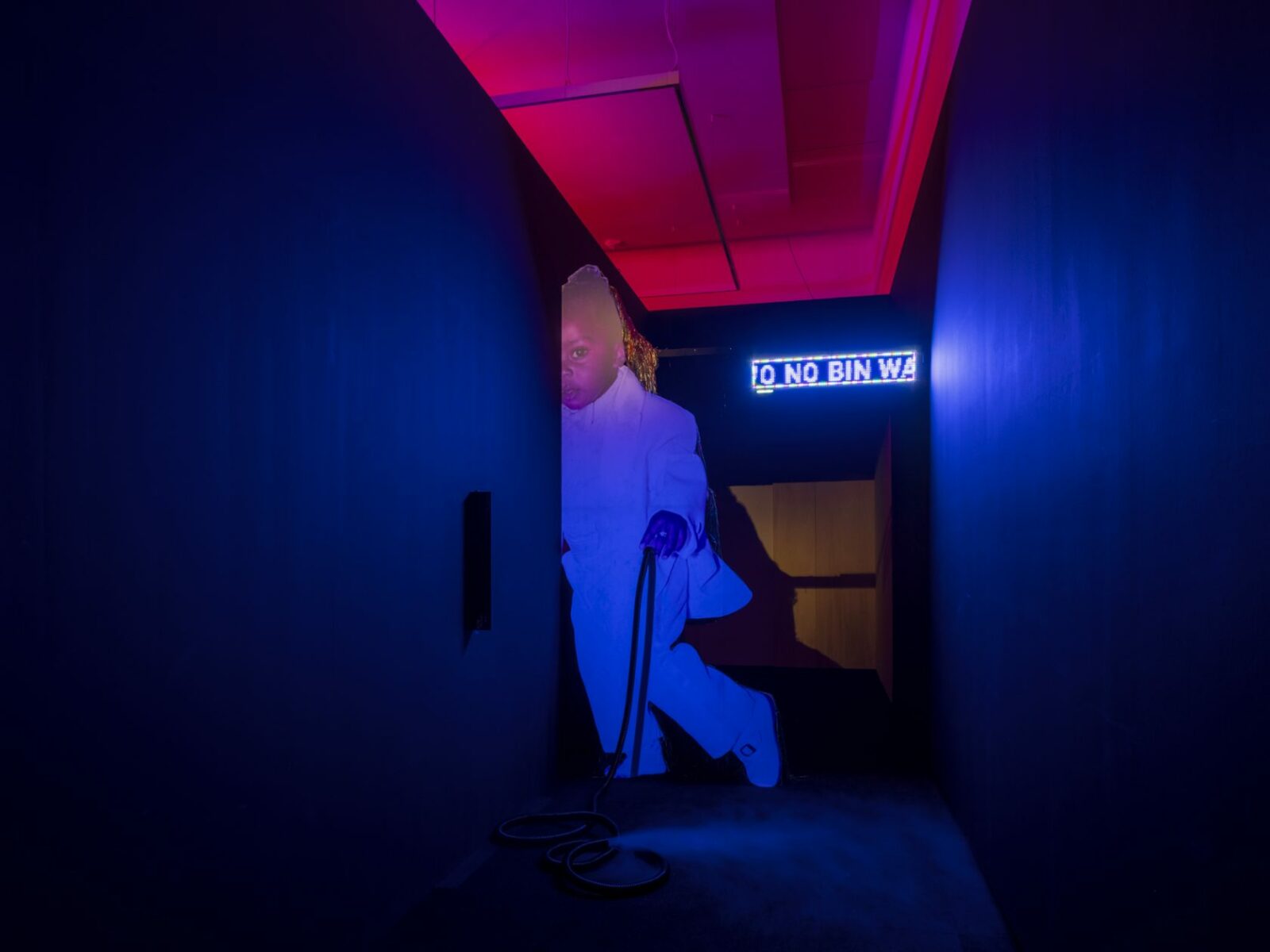
Upon entering Buro Stedelijk’s Central Space, you are met with a world where scale itself becomes unstable. Huge puppets loom and hover, their towering presence collapsing the distance between intimate gesture and monumental statement. These figures carry the visual vocabulary of Karnaval. Vibrant, excessive, coded with histories written in color and form. For those with eyes to recognize, the space hums with Afro-spiritual resonances: altars, symbols, and gestures that speak to lineages of knowing often rendered invisible within institutional walls.
Among these elements stands a first communion/baptism table, created by Kevin Osepa’s mother and visual researcher Suzette Martina. A domestic ritual made monumental, a sacred threshold placed at the heart of the installation. The table holds space for transformation, for the threshold between states of being.
Throughout the belly, archival images from the NAAM in Curaçao surface and resurface, images that once documented Afro-spirituality through colonial and anthropological frames. These photographs, frozen in time by gazes that sought to fix and categorize, are here given new breath. Following pathways opened by Saidiya Hartman’s critical fabulations, Osepa seeks to recontextualize these images, to free them from the violences of their original framing. The archives, once held captive in still frames and ethnographic distance, are set into motion within the belly. They pulse, they breathe, they move alongside the puppets and soundscapes. This is the work of liberating images from their confinement, allowing them to live again, differently. Here, in the Belly of Momo, the cursed and the holy are not separated but allowed to coexist, to touch, to transform one another.
Rozaly’s soundscapes weave through the installation, carrying sonic traces of Curaçao, the Caribbean, and the pulsing rhythms of carnival. These are not background atmospheres but active participants, shaping how bodies move and settle within the space. The sound becomes another collaborator, another voice in the collective authorship that defines this work.
This is not the product of a singular artistic vision but the result of many family and friends – a chosen and given constellation – who have gathered their skills, intuitions, and labor to bring this belly into being. The work bears the marks of many hands, many voices, many forms of care and knowledge passed between bodies.
Above all, the Central Space transforms into somewhere to simply be: to breathe, to let your shoulders drop, to release what you’ve been carrying. The belly offers permission to linger without purpose, to feel without interpretation, to let go.
The power of the stomach as a muscular site of opacity. Eating soup together becomes methodology. Communication beyond words, communion without explanation. Within the belly, we are fed; we gather around warmth. This is communication as it exists outside Western logics of literal speech: sensory knowing, embodied encounter, wisdom passed between and among bodies in shared spaces and elastic time. Maternal knowledge challenges myths of solitary artistic genius, insisting instead on art as relational practice, as care work, as wake work, as wisdom passed between bodies in shared space and time.
The many collaborations are crucial with the work of sound artist Rozaly and multidisciplinary artist Lakisha Apostel among many others. While this work bears Osepa’s name, it is also his mother’s: her image, her presence, her thought and touch, her practice is woven throughout.
Allow yourself to be entangled. Surrender certainty. Enter the belly.
The project space which is Buro Stedelijk’s Central Space has itself acted as belly: a living hollow, generative, sheltering spirits between manifestations. Between this show’s first conception and its physical installation, numerous collaborators have occupied and transformed this space. From small gestures to large interventions, from archives to immediacy of now. Some things remain to be determined; this open-endedness is the method. The belly is precisely where form stays fluid, where the unresolved can breathe.
As my final curatorial project here, The Belly of Momo feels less like an ending and more like a distillation of what Buro Stedelijk’s Central Space has offered: a threshold space where institutional critique and creative possibility coexist, where Caribbean epistemologies can be centered rather than marginalized, where the experimental is not exceptional but foundational. This show carries forward the methodologies that have animated this space. Collectivity, porosity, the refusal of singular authorship, the insistence on embodied knowledge.
The Belly of Momo becomes ritual space where you don’t merely observe but become entangled in Karnaval’s coded visual and affective language. You are asked to slip, to surrender certainty. This is what temporary structures offer: permission not to know, to dwell in complexity, and to trust that meaning emerges through feeling and proximity rather than didactic explanation. The belly holds what ‘formal institutions’ cannot: the space between clarity and opacity, the threshold where transformation begins.
Inside the belly, sensory saturation creates conditions for collective experience: sounds, vibrations, sacred and cursed layered together. You are invited to inhabit it all-joy, mourning, renewal, and the political reclamation of space. Experience what happens when we linger between categories, between endings and beginnings, between what was and what might be. This is an invitation to enter a space where contradictions are not problems to be solved but conditions to be inhabited.
Here, practice becomes political reclamation: asserting Caribbean epistemologies within institutional space, insisting on embodied, non-literal forms of knowing long marginalized yet deeply woven into the Netherlands’ reality. The belly makes room for what has been kept outside.
It is not disappearance but transition. The closing chant: ‘Ayo Momo’ becomes a technology of continuity. A call that insists even erased spirits rise again, endings contain beginnings.
We gather here to make noise together, to cry together, to eat soup together. Not to let go, but to remember how we gathered in the threshold, how we occupied this experimental place and dared to imagine, time and time again, as a collective body.
‘Ayo Momo’
Ook adverteren op mistermotley.nl? Stuur dan een mail naar advertenties@mistermotley.nl