
Driftwoods
Op zaterdag 14 februari opende The sound of night falling in the other room, de solotentoonstelling van Bart Lunenburg in Galerie Caroline O’Breen in Amsterdam. Voor zijn beeldende projecten doet Bart regelmatig onderzoek. ‘Als kunstenaar wonend in deze stad, en met hout als belangrijkste materiaal in mijn praktijk en met een grote liefde voor architectuurhistorie, ben ik nieuwsgierig naar de verdwenen houten huizen van Amsterdam. Naar de verborgen houtconstructies die schuilgaan achter gestucte plafonds en witte muren, verborgen achter monumentale gevels en de klinkers van de straten. In mijn onderzoek ben ik verschillende verborgen bouwlagen tegengekomen die ons dagelijks dragen en omhullen, zonder dat we het doorhebben. Dit onderzoek naar historische verhalen en stedenbouwkundige processen, bekeken vanuit het perspectief van houtbouwtradities, vormt de basis voor nieuwe installaties, sculpturen en foto’s.’ Vandaag publiceren we de Engelse vertaling van Barts essay dat voortgekomen is uit dit onderzoek, naar aanleiding van de Warmoes Biënnale die op 7 maart opent en waar Barts werk te zien is.
Translated by Michiel Huijben.
In the lower reaches
Beneath the surface of the city where I live lies an immense forest. Amsterdam is known as a city built on stilts, which, just like in many other Dutch cities, form the foundations of its buildings. Together, these poles create a forest that has supported the daily activities of residents above it for hundreds of years. Living in the crowns of these underground trees lacking branches or leaves, the city’s inhabitants have themselves become its canopy. In this forest, all seasons occur simultaneously. New leaves are constantly growing and old leaves die off, only to be absorbed into the marshy peat soil on which these trees were planted.
In times of hyper-commercialism and mass tourism in a city like Amsterdam, at first glance there is almost nothing left of the city’s origins. Or the way in which Amstelredamme, a small settlement of wooden houses around the dam in the Amstel, developed over the centuries into a city with almost one million inhabitants. It’s even more difficult to imagine the number of trees, at least ten times the current number of inhabitants, that were needed to sustain the city’s growth.
In 2025, during the 750th anniversary of Amsterdam, more attention was suddenly paid to the history of this originally medieval settlement. It’s a city that could not have existed without the enormous human effort of building on very impractical terrain. In De Houten Eeuw van Amsterdam (The Wooden Century of Amsterdam, Prometheus, 2013), architectural historian Gabri van Tussenbroek (1969) describes the urban development of medieval Amsterdam and, in particular, the indispensable role that wood played as a building material. Some 750 years ago, the first wooden houses on the banks of the IJ and Amstel rivers had no foundations at all. After a period of more than ten years, these wooden structures had to be demolished and rebuilt because they sank into the marshy peat of the Dutch landscape, which then still consisted mainly of lakes and swamps.
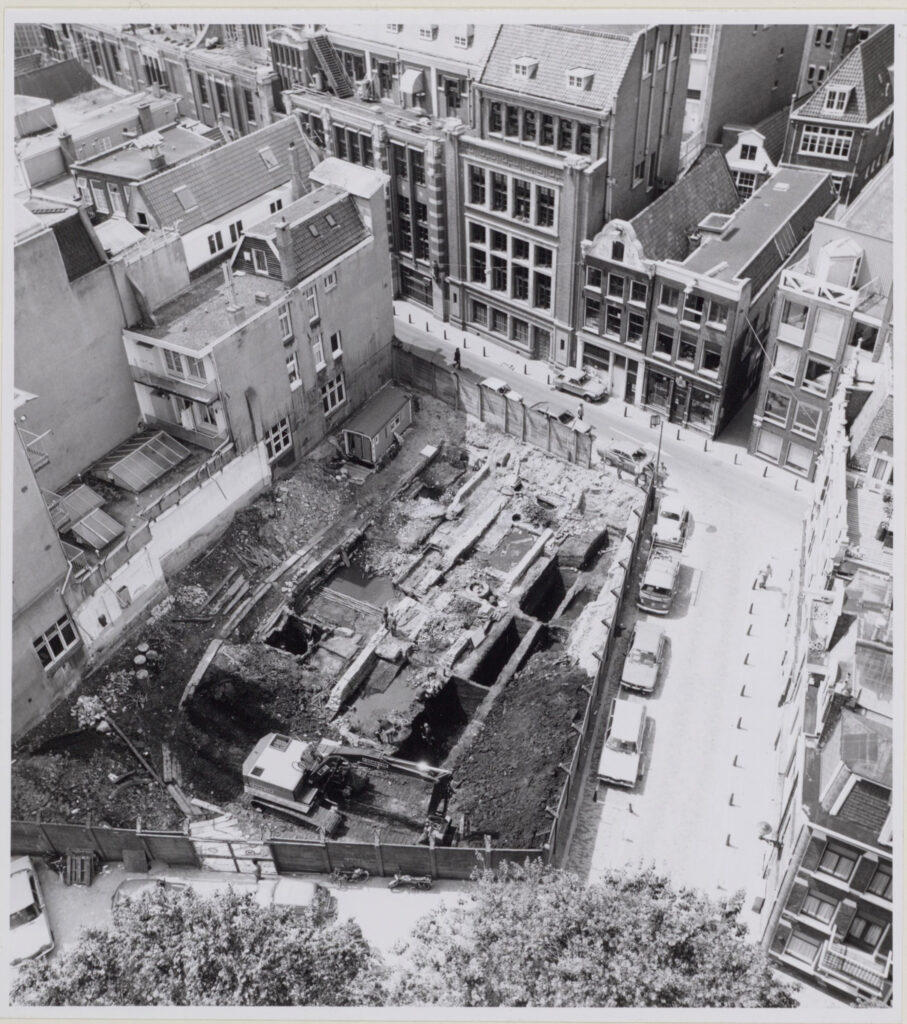
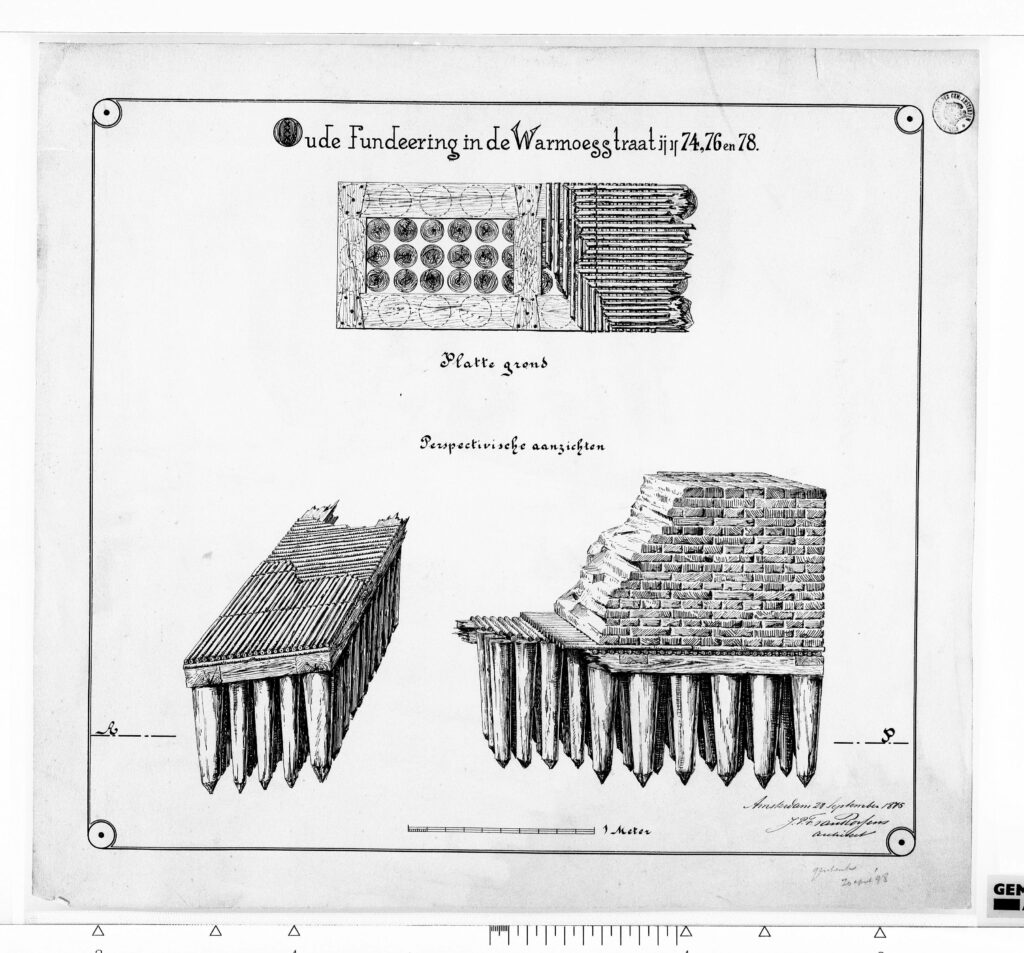
In 1983, during the demolition of some houses at the intersection of Warmoesstraat and Oudekerksplein, streets that are among the oldest in Amsterdam, archaeologists found underground layers of as many as sixteen different houses. Due to continuing subsidence[1] and the demolition and reconstruction that followed it, a bizarre accumulation of wooden structures developed over the centuries. The foundations of one house remained to serve as a support for the next. During another excavation a little further along the Rokin, archaeologists discovered that the so-called poeren[2] had been made from the remains of a dismantled ship. Building materials were expensive and scarce, so people used whatever materials were available to them. Ships became foundations, and dismantled wooden frames formed the building materials for new houses.
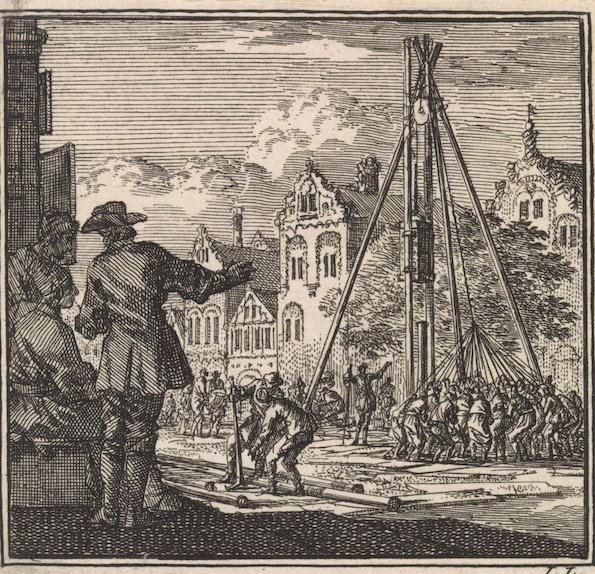
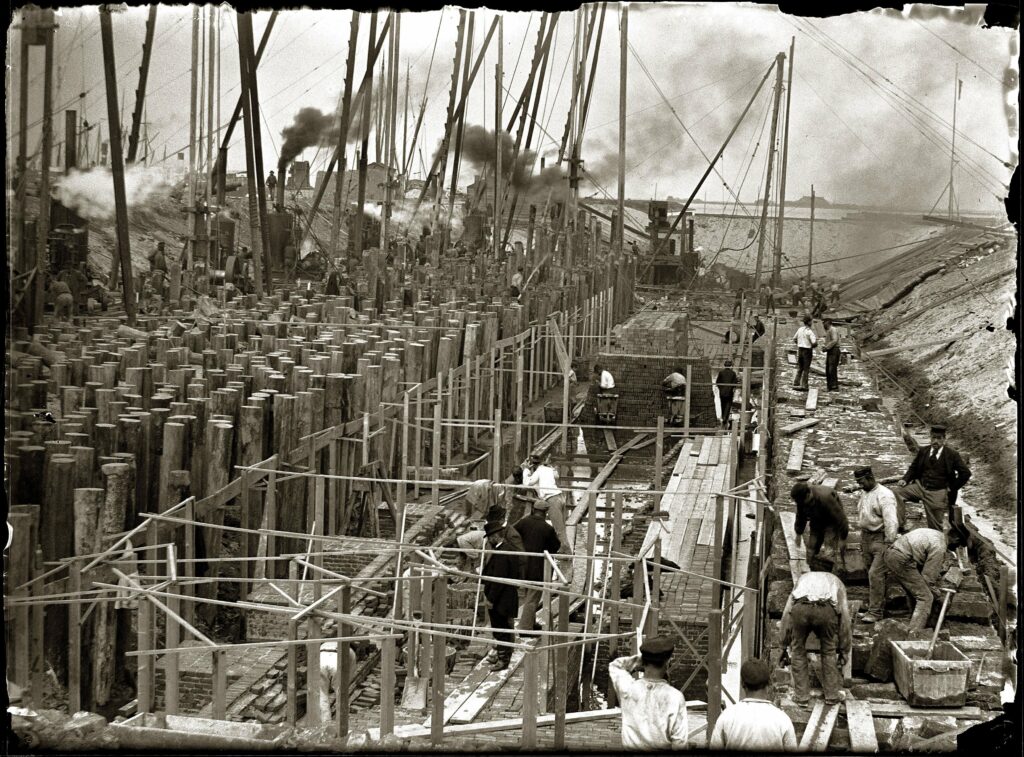
I try to imagine what it must be like to rebuild your own home time and time again, while the marsh beneath the city constantly pulls it down into the depths. This sense of transience, but also of resilience on the part of the city’s former inhabitants, strikes me as both moving and admirable. Perhaps that’s also because, for the past two years, I too have been living in a house that was never intended to remain forever. This emergency housing, built in 1918 and constructed largely of wood, was built in Amsterdam-Noord at a time when large influxes of both Belgian WWI refugees and residents of overcrowded working-class Amsterdam neighbourhoods such as the Jordaan moved there. After a decade or two, it was to be demolished by the municipality, along with several other temporary garden villages. More than a hundred years later, these homes (also lacking a foundation) are still standing. The housing crisis has never ended, nor has the threat of subsidence due to marshy land and the possible demolition that still hangs over these houses.
As an artist living in this city, with wood as the primary material in my practice and with a great love for architectural history, I am curious about the wooden houses that have disappeared from Amsterdam’s history. About the hidden wooden structures, concealed behind plastered ceilings and white walls, behind monumental façades and cobbled streets. In this text, I would like to share with you my search for the various hidden layers of construction that I have encountered in my recent research. Layers of construction that support and surround us every day, without us even noticing. This research into historical tales and processes of urban development, viewed from the perspective of timber construction traditions, forms the basis for new installations, sculptures, and photographs.
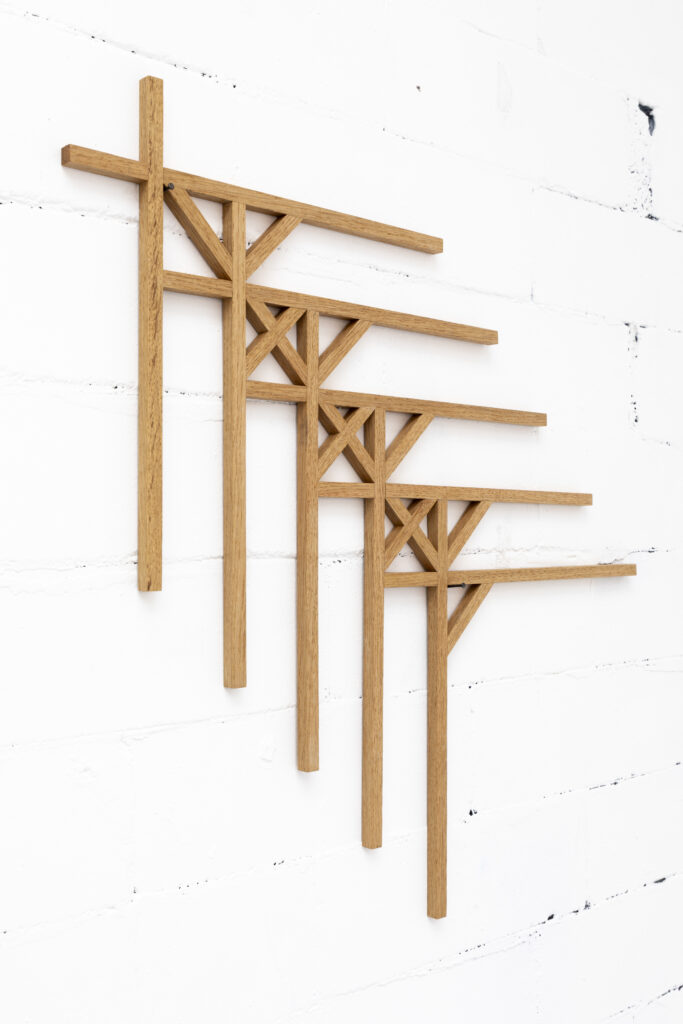
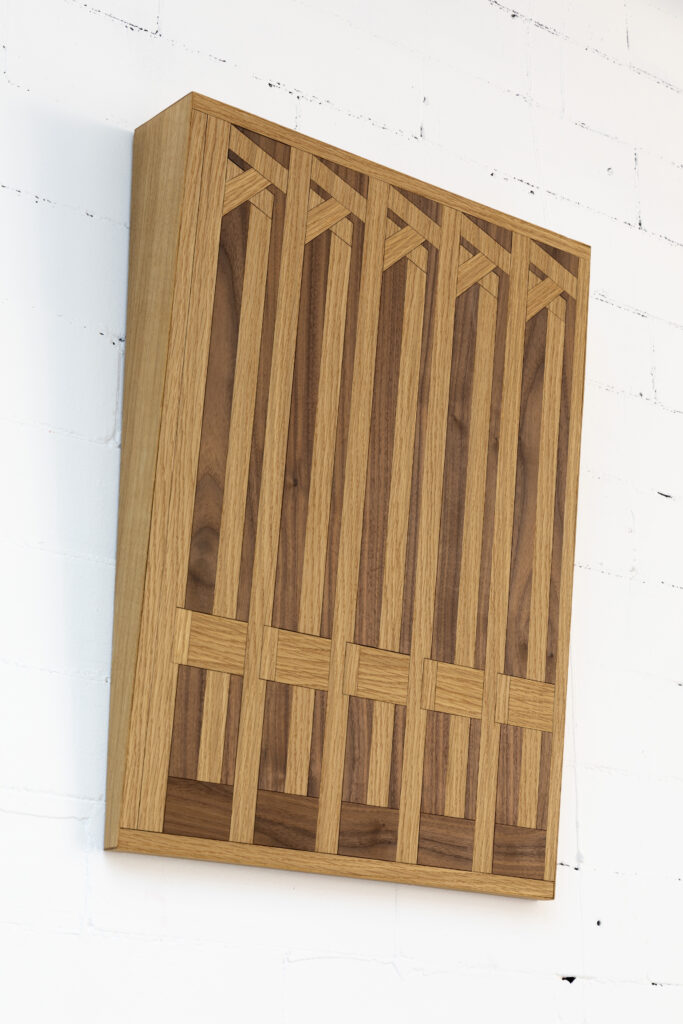
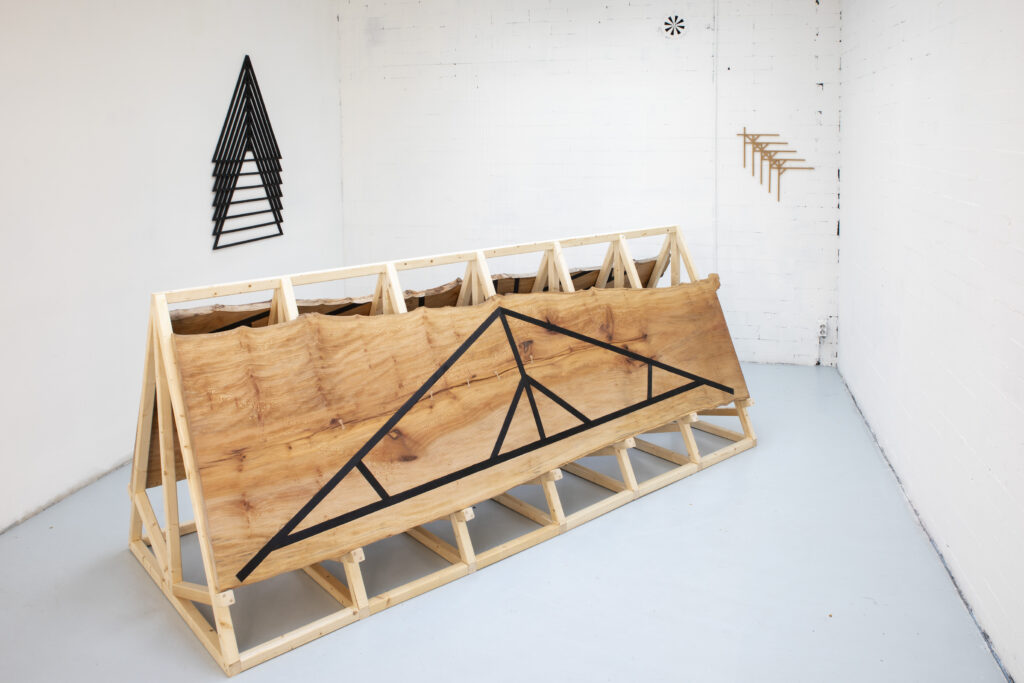
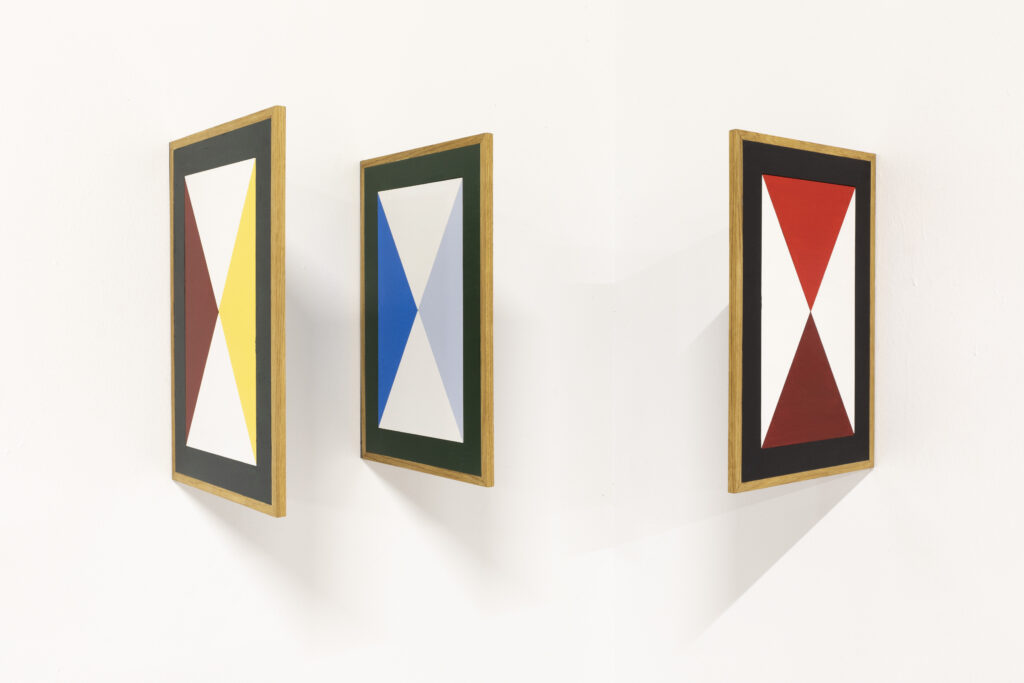
This is how the archaeological excavations mentioned above, which bear witness to a dizzying cycle of construction and demolition in the oldest parts of the city, form the starting point for the new series Oever (Bank) (2025 –26). In these oak sculptures, I intertwine various wooden roof and truss constructions as medieval initials. In another work, an inlaid wooden construction hangs above the visitor’s head, sloping over them slightly, like a sculptural representation of subsidence. Elements such as repetition, rhythm and reiteration form material reminders of the resilience of the city’s former inhabitants. The accumulation of lines and structures is not only an abstract translation of movement, effort and labour, but also forms a still image. The works bear witness to these stacked layers, like the side of a sheet of plywood or a slice of layer cake. Silent and hidden structures that lie beneath the surfaces of the city.
Because of the threat of subsidence and city fires there are hardly any (completely) wooden medieval buildings left in Amsterdam. Just a few old wooden houses have been preserved, such as In ‘t Aepjen on the Zeedijk (known from the proverb In den aap gelogeerd) and Het Houten Huys on the Begijnhof, as well as the Oude Kerk, the city’s oldest surviving wooden building. In 1452, three-quarters of the city’s wooden houses went up in flames during a city-wide fire. It was because of disasters like this that in 1521, the Emperor Charles V demanded that all wooden façades of Amsterdam houses be torn down and replaced with stone ones to prevent future fires from spreading. Dendrochronology (or tree-ring analysis), the science of dating wooden objects based on the growth rings visible on objects, shows that medieval timber-frame structures lie behind many 17th- and 18th-century facades.
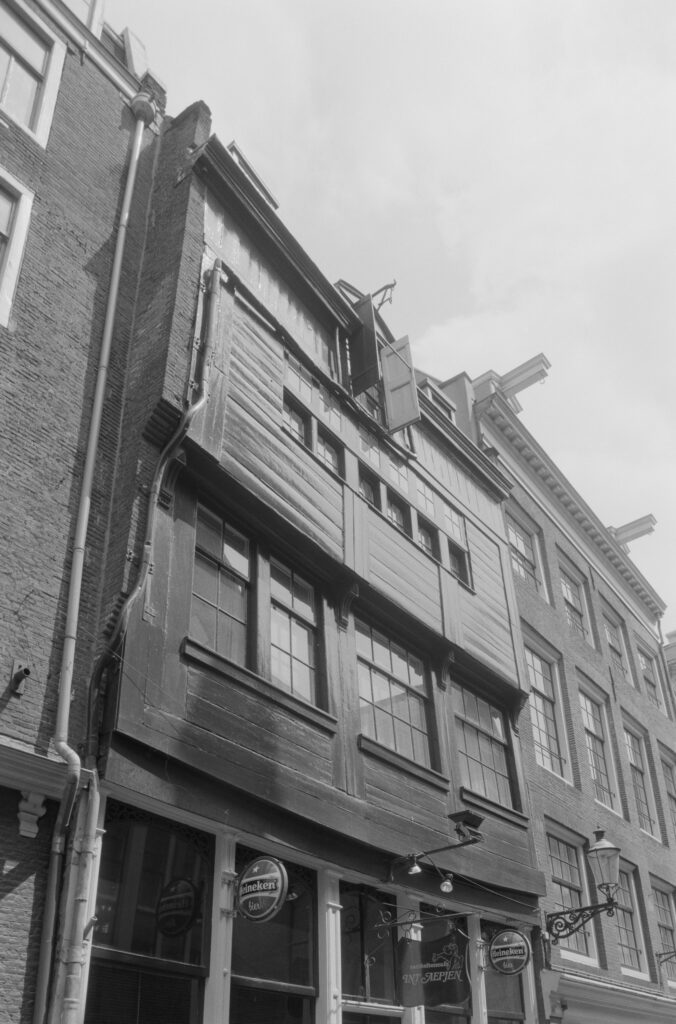
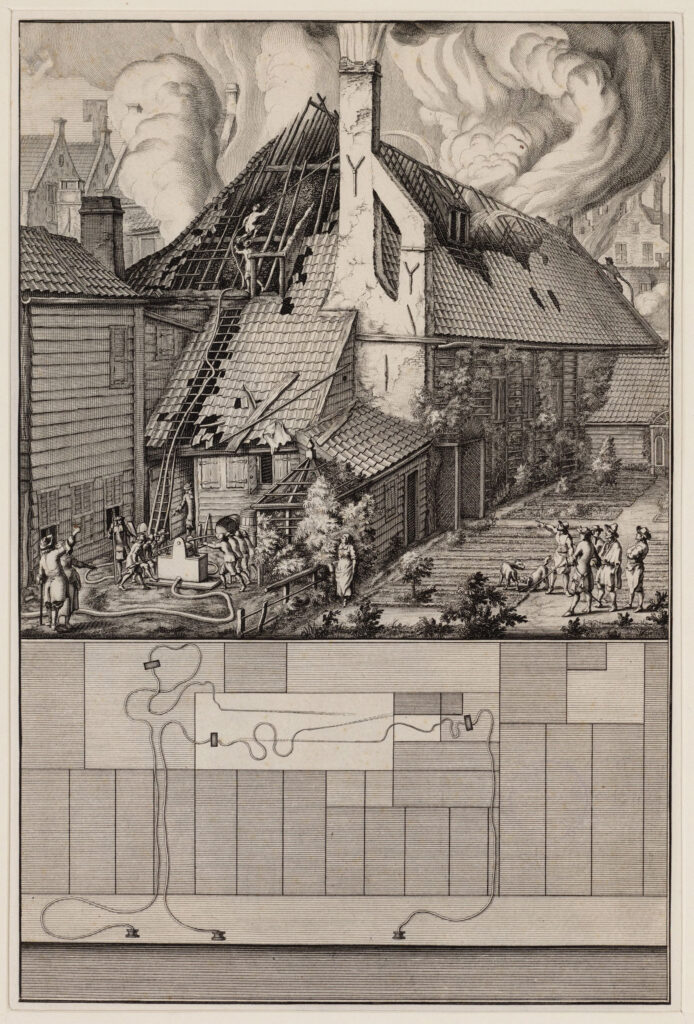
Amsterdam’s wooden history is not only hidden under-ground but also behind the façades of its houses. With the introduction of brick and natural stone, and heavier and heavier buildings as a result, foundations had to be laid that reached much deeper into the ground. Most people know that Amsterdam is a city built on poles. It’s interesting to consider where all that wood came from, knowing that most of the primeval forests in the Netherlands were already rapidly disappearing in the Middle Ages.
In the upper reaches
Hidden timber framing
Looking out of the window of Weilermattes, an old farm complex in rural German Rhineland-Pfaltz, the quietly babbling Brohlbach river crosses the valley in the distance, toward the wide stream of the nearby Mosel river. On the steep hills along the banks of this river rise the vineyards producing wine of the same name. This is where I am staying for a few weeks as artist-in-residence, at the invitation of former gallery owner Wilfried Lentz and Carla de Kovel, to conduct research into local timber construction traditions in the farm complex they are developing into an art house annex artist-in-residence.
During my residency, I meet Harry, a local Schreiner[3] who, like many residents of this originally agricultural area, leases forest land in the vicinity. Carpenters like Harry control the entire production process themselves: from growing and felling their own trees to sawing and drying them, including building furniture and interiors with this self-processed wood. During the residency, I am the first occupant of the new house designed by Atelier Tomas Dirrix, which has been added to the farm complex. The walls of the rooms are made of Kiefer pine wood from Harry’s own forests located on the grounds of the picturesque Burg Eltz castle nearby.
During the restoration of the old main residence of this farm complex, the originally wooden half-timbered façade was revealed from beneath a thick layer of stucco. This oak latticework had been hidden from view for many years. Apparently there was something repulsive about the house’s rough wooden frame that made the previous occupants, like some other residents of this village, decide to conceal this support structure from view. Perhaps motivated by a desire to break with the village’s poor agricultural past. A need to hide the dark wood, full of mortise and tenon joints, tightly woven with willow branches and smeared with clay and animal remains, under freshly plastered white walls.
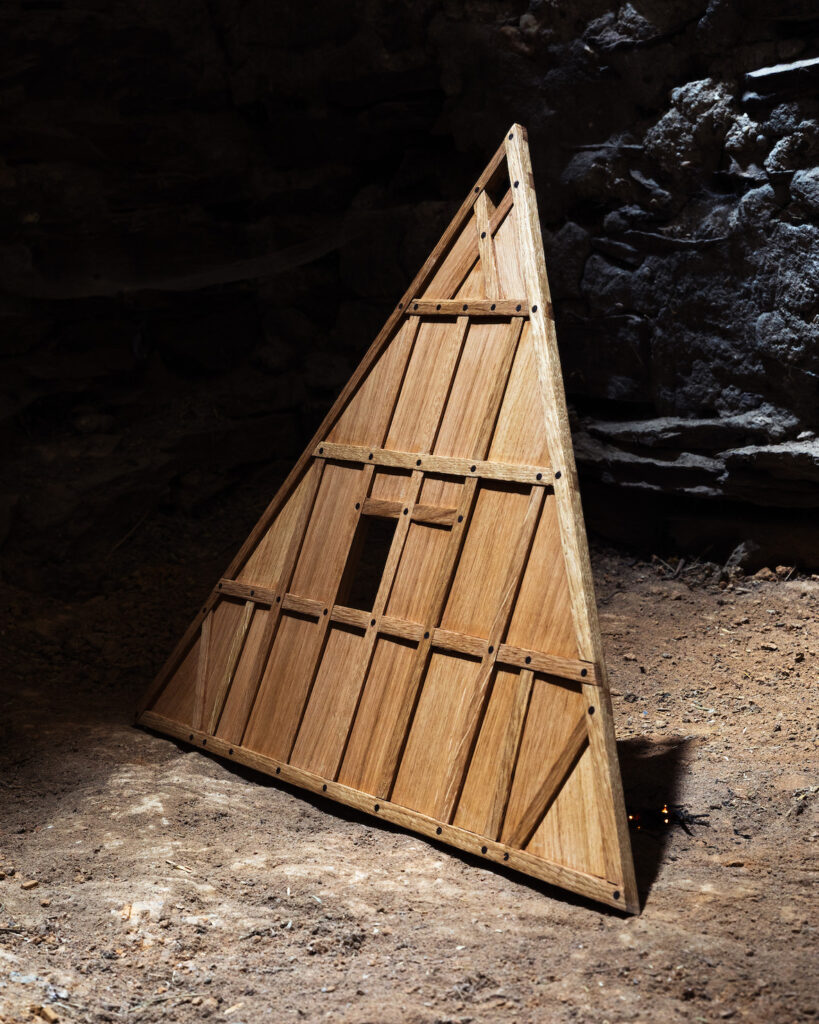
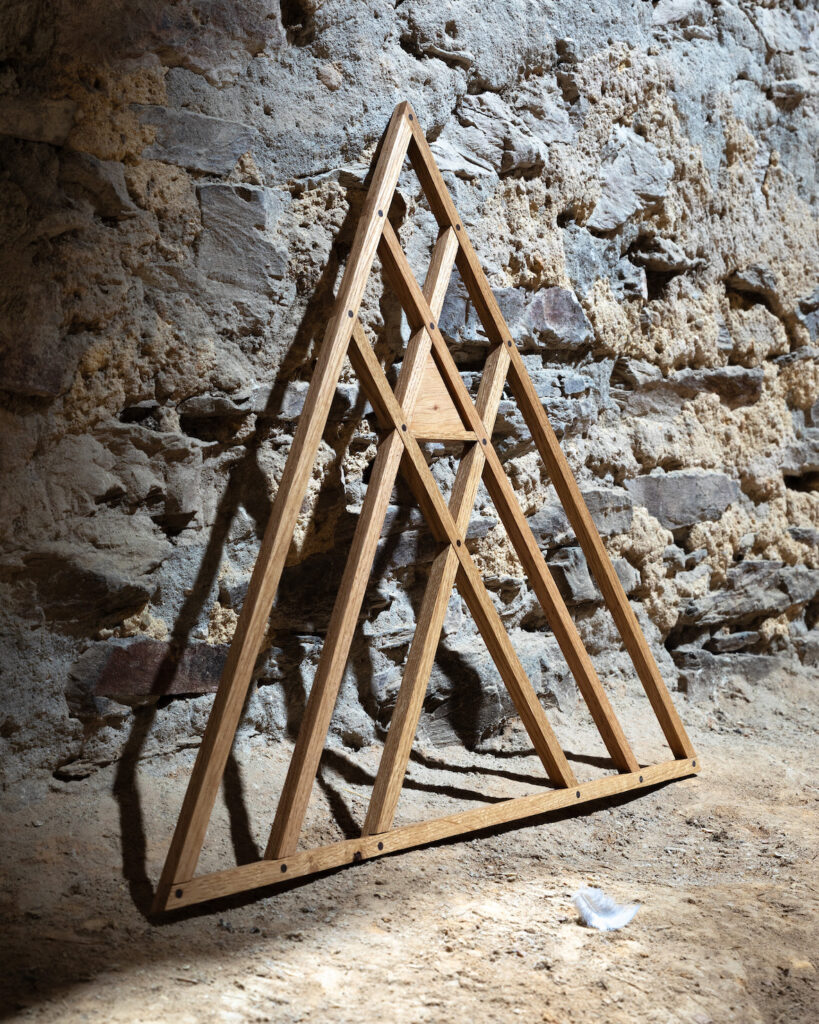
By hiding different historical building layers, the farm’s previous owner did everything he could to de-monument his house. By literally removing the heritage status of one of the oldest houses in Brohl, he spared himself the interference of local heritage conservation authorities. While cleaning the oak parts of a demolished staircase from the farm, I discovered a piece of laminate that had been left behind which had previously covered the stairs. Laminate with, of all things, an oak print on it. Here, too, I sense a distaste for the sight of solid wood construction. Covering oak with a representation of oak is precisely the denial of a building material that the Austrian architect and theorist Adolf Loos (1870 – 1933) rails against in his famous book Ornament and Crime (1908). His principle of cladding prohibits the cladding material from taking on the properties of the underlying material. This doctrine strives for the most honest approach possible to (building) materials, such as the idea that wood may be painted in any colour, but may not imitate tones, colours or other types of wood.
Hidden colour layers
Removing the layers in the old farmhouse not only revealed the honest load-bearing structure of the house, but the walls also revealed their many underlying layers of colour. The deep blue hue of the lines and floral motifs that emerged from under the stucco in the bedrooms during the same renovation of this old farmhouse is reminiscent of Yves Klein Blue. As an alternative to often expensive wallpaper, poor farmers painted ornamental designs on the walls using a paint roller carved with decorative patterns. Given my interest in changing meanings and uses in vernacular painting, I was immediately intrigued by this mysterious, hidden layer of colour in the bedroom. An intense shade of blue that I initially could not reconcile with the shades of grey and brown of the austere German (and Dutch) countryside. A layer of colour that, like the solid wood timber frame, had remained hidden beneath the surface of the wall for decades. This prompted me to delve into the history of blue and the role it has played in the countryside of North-Western Europe.
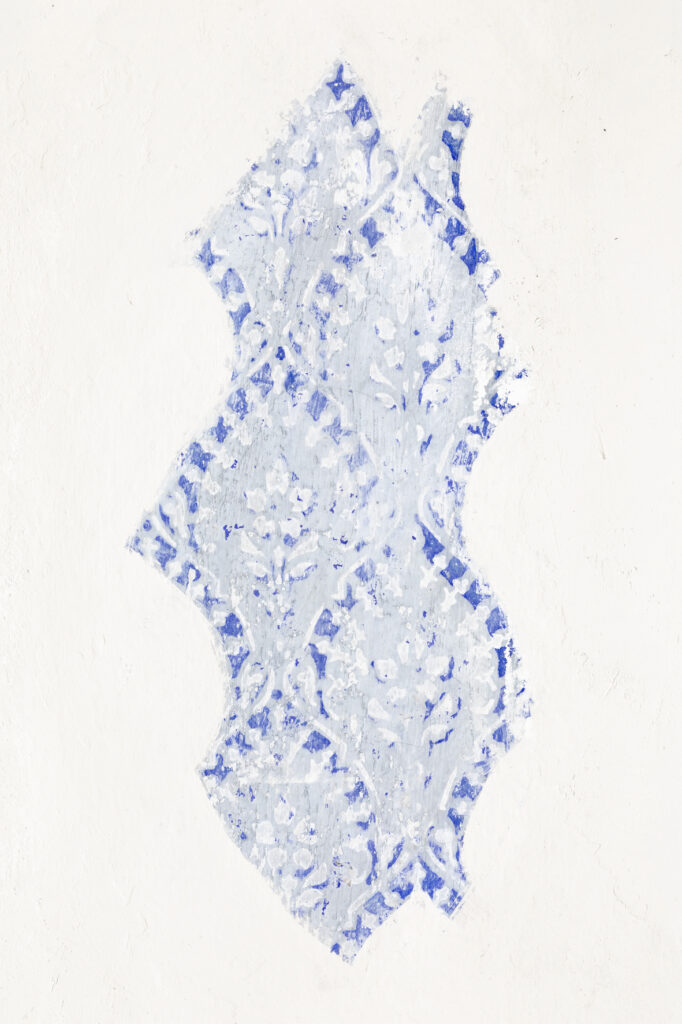
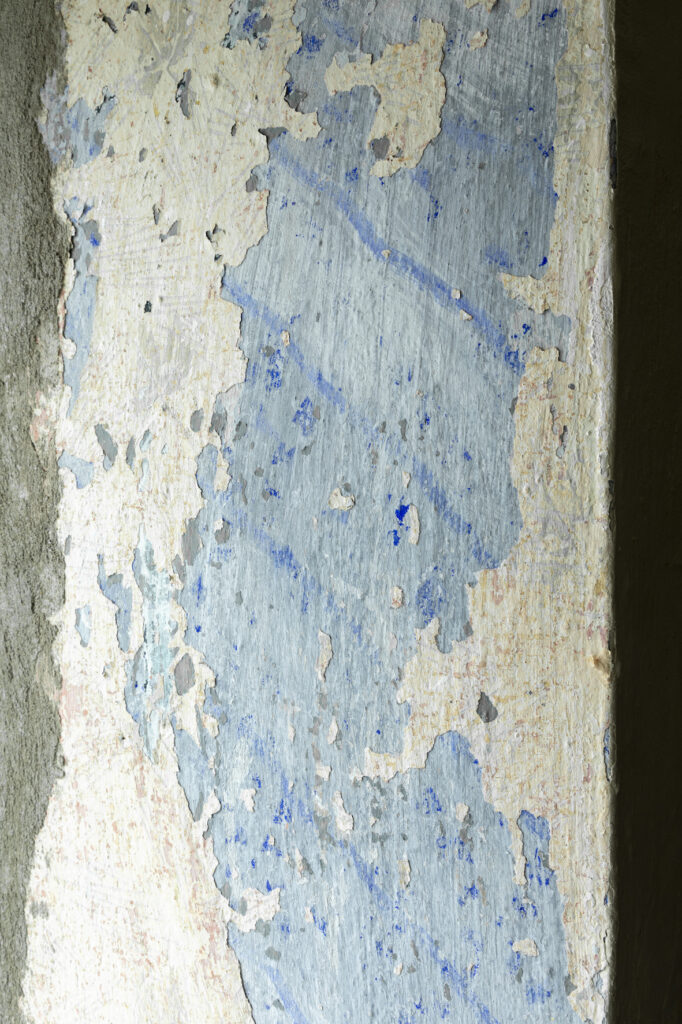
From the Middle Ages onwards, blue was extracted from the woad plant (also known as European indigo), later by grinding blue glass (smalt) and later still by grinding and purifying lapis lazuli, or ultramarine blue. For a long time, this type of blue was more expensive than gold and was therefore exclusively reserved for clergy and nobility. However, in the mid-19th century, the period in which this farmhouse was built, a turning point occurred when chemists succeeded in synthetically replicating this shade of blue. This synthetic ultramarine blue was even more intense than the blue shade from gemstones, and could be produced on an industrial scale. During this period, ultramarine experienced a phenomenon that the Germans call gesunkenes Kulturgut[4]. Suddenly, the shade of blue was widely available, allowing the peasantry to associate with the high cultural cachet of ultramarine. The previously status-enhancing pigment was now mixed into lime paint and applied to the clay infill of the half-timbered walls of common farmhouses.
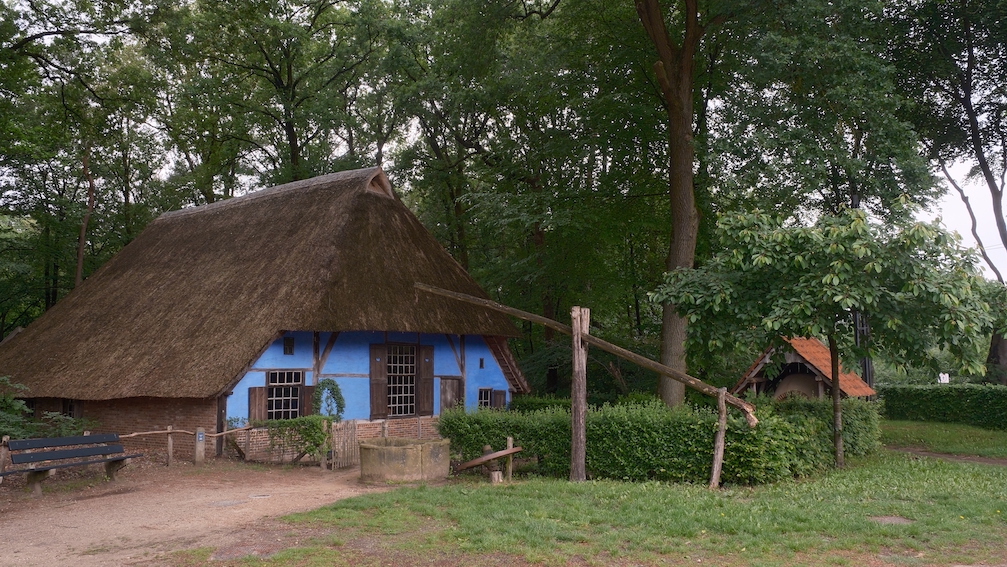
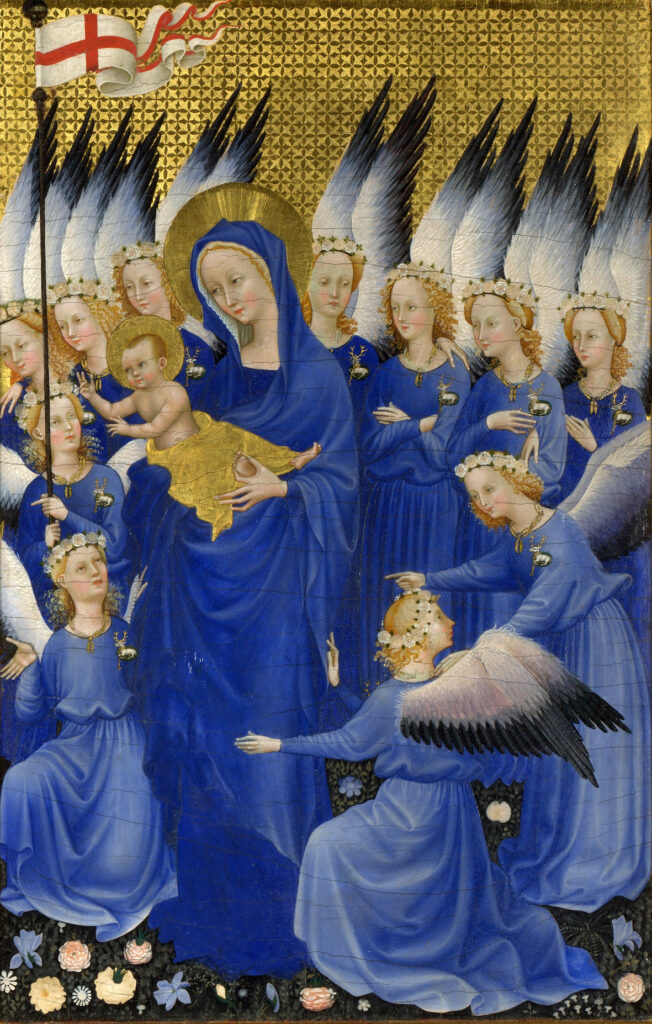
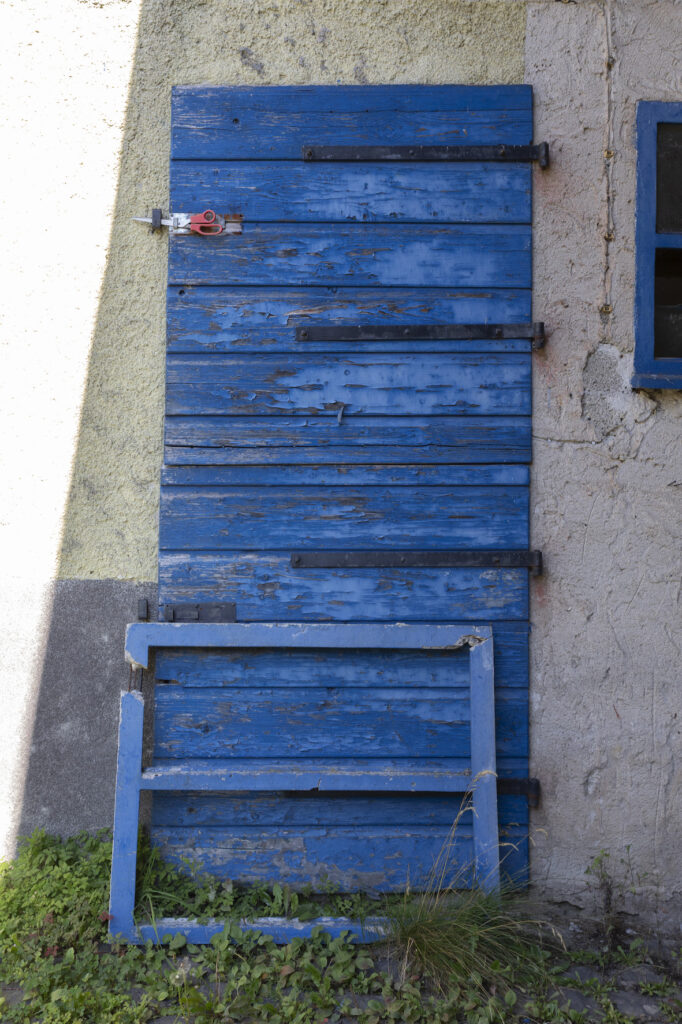
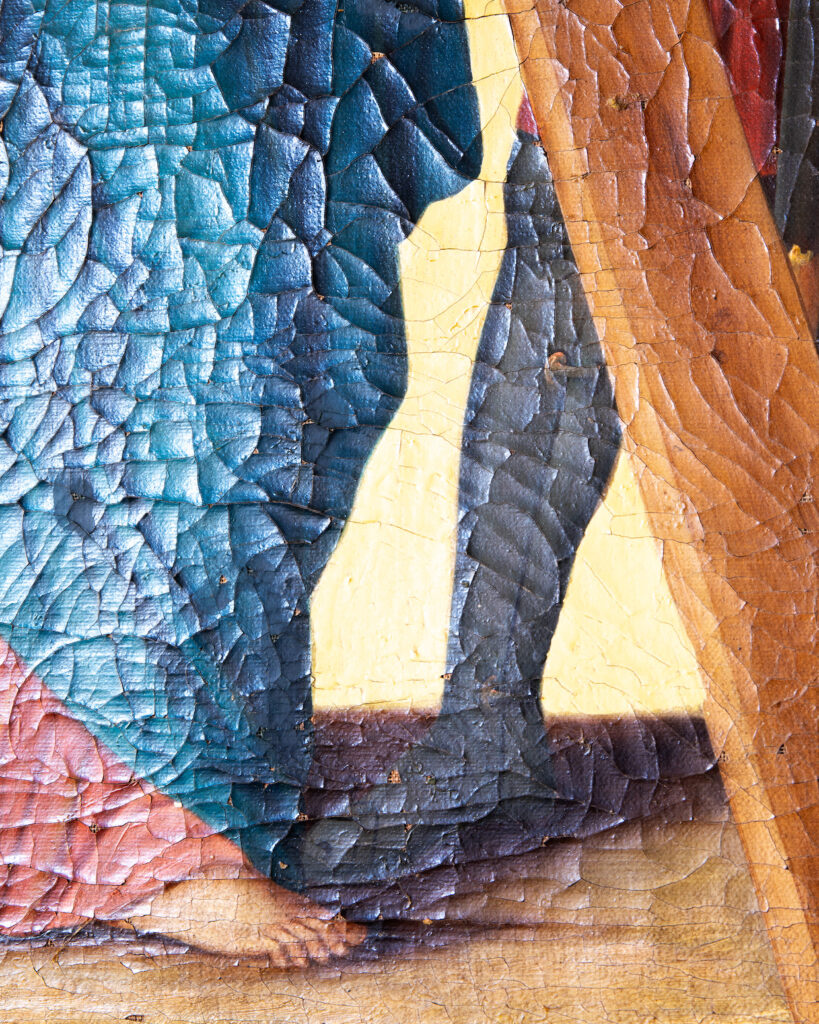
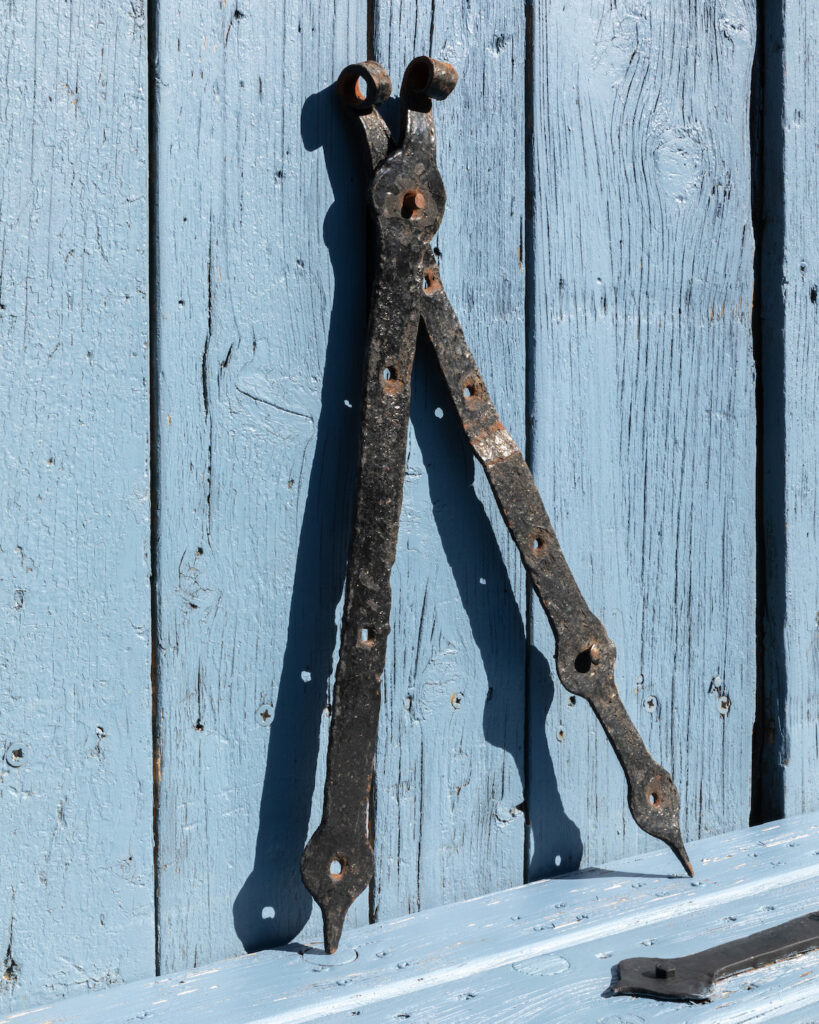
After seeing the layers of colour in the bedroom, I also find the blue in Brohl’s austere village church. It colours the craquelure-affected robe of Christ in the series of paintings depicting the fourteen stations of the cross. In the centre of the village, on the shutters and doors of an abandoned farmhouse right next to the church, I also find the peeling remains of a layer of synthetic ultramarine paint. A pair of red scissors stands out sharply against the deep blue background — as a temporary solution, it had presumably been stuck into the door handle by a former resident. In all likelihood, many more kitchens, bedrooms, living rooms, barns and stables in this village have experienced a deep-blue phase.
Painting walls is a form of appropriation. It’s more or less one of the first things we do when we move into a new room. In doing so, we cover up the history of a space, erase the traces of our predecessors and make the architecture around us our own. We add a layer to the accumulation of layers that our predecessors have added to the wood, lime, brick and concrete of our homes. Just like all those houses located in and on top of the houses in Amsterdam’s city centre, this farm contains an accumulation of rooms. There is not one single house, but there are houses within houses, rooms within rooms. The blue room is sandwiched between a white plastered room that hides it from our view, and another room that is in turn hidden by the blue room. All those presences, all those lives, are still here, in this place. They never really left
A falling shadow
When you close the grand taubenblaue[5] entrance door of the large barn of Weilermattes behind you, it’s almost completely dark inside. Once your eyes have adjusted to the darkness, you can see the soft light shining down from a single wall niche and the owl hole in the barn. These sparse openings in the wall wrap the building’s interior in a theatrical, agricultural darkness which, because of its mysterious quality, could, in my opinion, be declared intangible heritage.
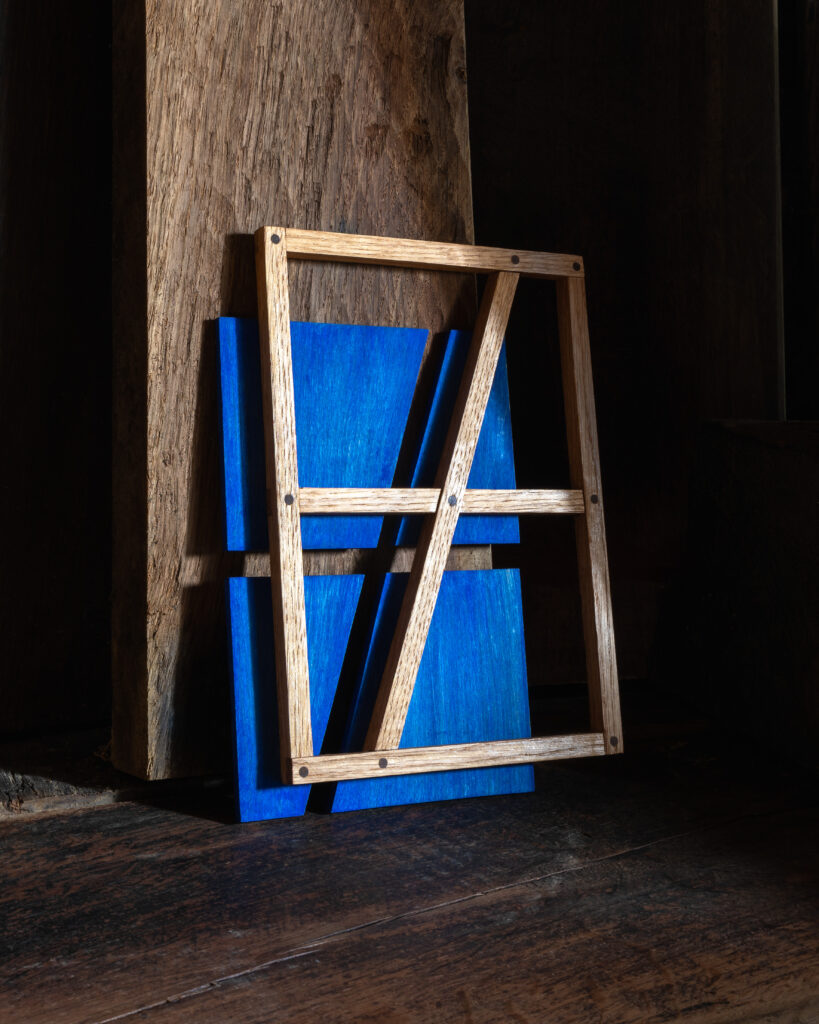
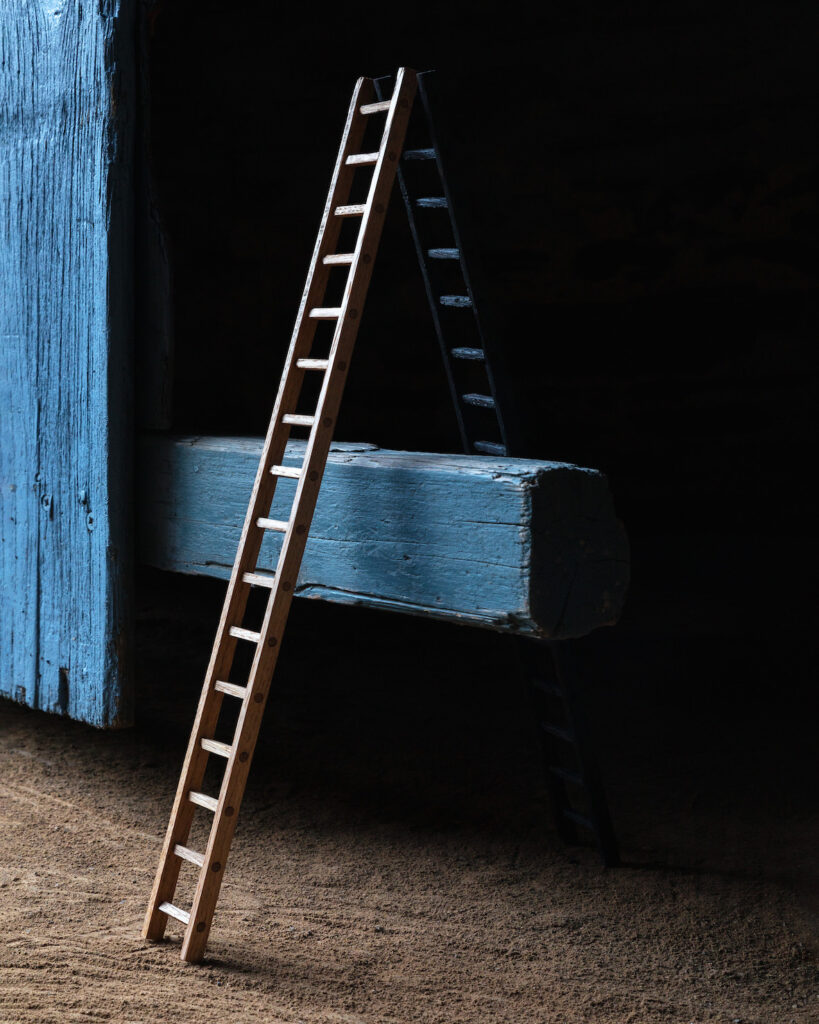
This shadowy barn houses the space that serves as both setting and subject for Nocturnes (2026). The objects in this photographic series of still lifes are a cross between utensils, architectural structures and sculptural objects. The objects support each other or lean against the quarry stone walls. They are alternately belongings left behind by the previous occupants and sculptures built by myself during the residency period. The series of photographs is an attempt to understand the nature of this place, with its local building and painting traditions, human traces and the changing surrounding landscape. The works include studies of the wood joints in the local half-timbered houses and equipment such as the many abandoned ladders.
The darkness of this barn, which I visited daily during my residency, strongly reminded me of the shadows in the essay In Praise of Shadows (1933) by Japanese writer Jun’ichirō Tanizaki (1886–1965). The foreword to the English edition quotes the famous statement by Estonian-American architect Louis Kahn (1901–1974): ‘The sun never knew how wonderful it was, until it fell on the wall of a building.’ Charles Moore argues in the introduction that Western architecture works with the sun and that the sculptural quality of architecture is found in the shell of the building. The sunlight and the skin of the building complement each other, bringing out the best qualities in each other.
In this practical but majestic rural structure, built from weathered oak wood full of woodworms, with clay floors and rough quarry stone walls, I recognise something of the monolithic quality of the buildings designed by Louis Kahn and his modernist colleagues. These heavy, rough structures reveal their load-bearing construction. Compared to the sculptural muscle-bound work of these 20th-century architects however, this vernacular building has something unspectacular about it. It was built, not designed, created gradually, adapted over time and never fully completed. The beauty of this vernacular timber frame lies precisely in its lack of design: it was created through craftsmanship, necessity, limitation and practicality.
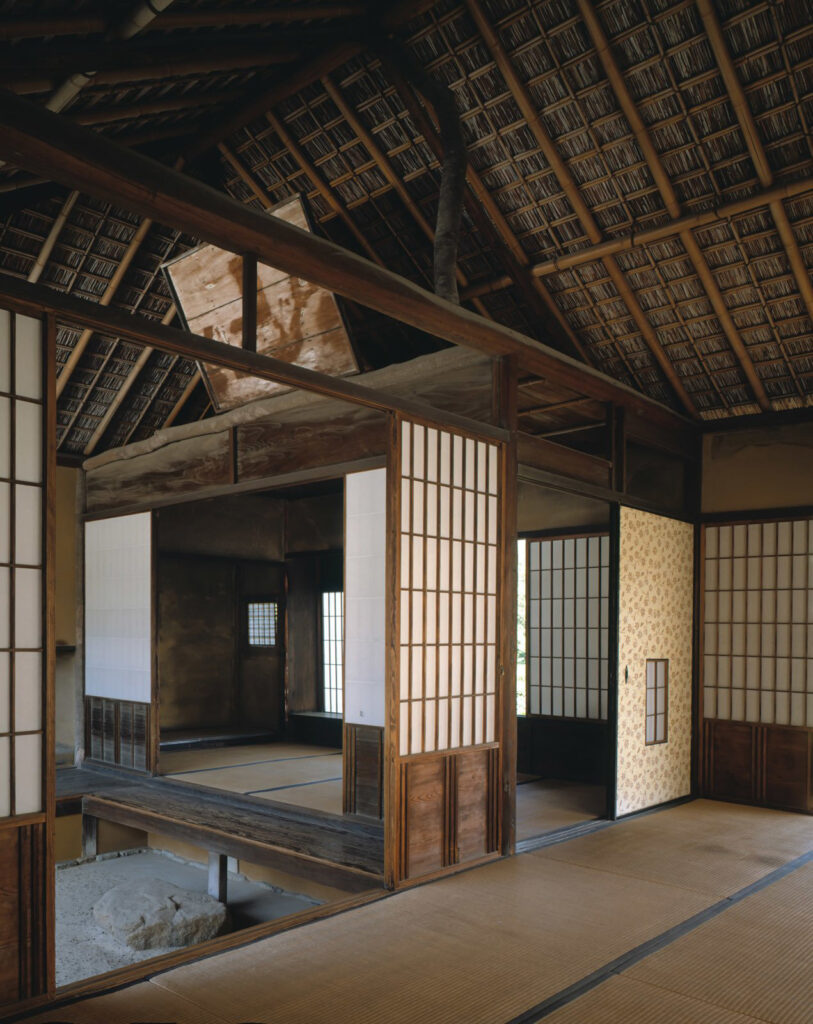
‘In making for ourselves a place to live, we first spread a parasol to throw shade on the earth, and in the pale light of the shadow we put together a house.’ Here, Tanizaki describes his idea of the basis of architecture. In contrast to hard-surfaced and sharp-edged (modern) Western architecture, which revolves around banishing shadows from interiors, traditional Japanese architecture focuses on shadows, soft transitions and emptiness. Because of the stretched eaves of a traditional Japanese building, no direct daylight enters the house except at sunrise and sunset. The sunlight that is broken up by the roof creates an elaborate transition from light to dark, outside to inside. The resulting mysterious shadows are an immaterial but essential architectural element in this form of architecture. Traditionally it was within this twilight, which invites contemplation, where Japanese poetry, ceramics and painting were created
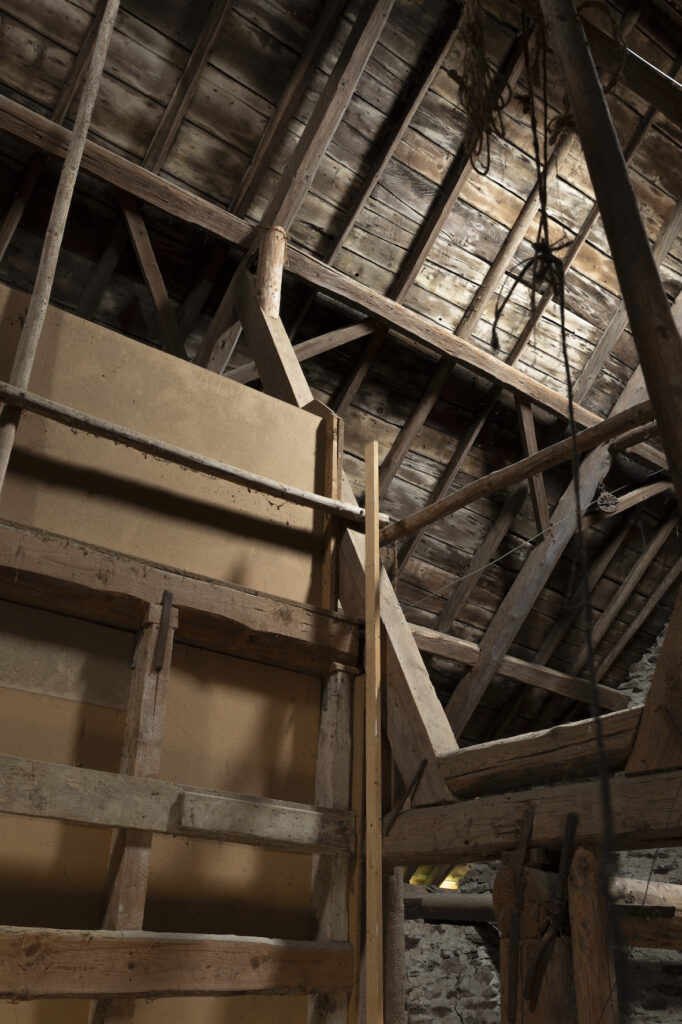
In his essay, Tanizaki laments the emerging Western influences in Japan, driven by industrialisation and mass production. Shadows, which are so important in his culture, were in danger of losing ground to the harsh, direct daylight of emerging Western architecture. In contrast to, for example, smooth and white Western ceramics, traditional Japanese pottery revolves around what Tanizaki calls ‘the sheen of antiquity’. Through use and the passage of time, objects acquire a lively patina, an animation that is impossible to replicate in a factory.
It is precisely this subdued, calm darkness that is draped like a veil over the objects in this barn. From a Western point of view, the patina of antiquity would make these ladders, stair parts, old brooms, rusty tools and the metal fittings of a vanished door pass for old junk. But these objects cannot be made; they can only come into being and acquire a soul through use.
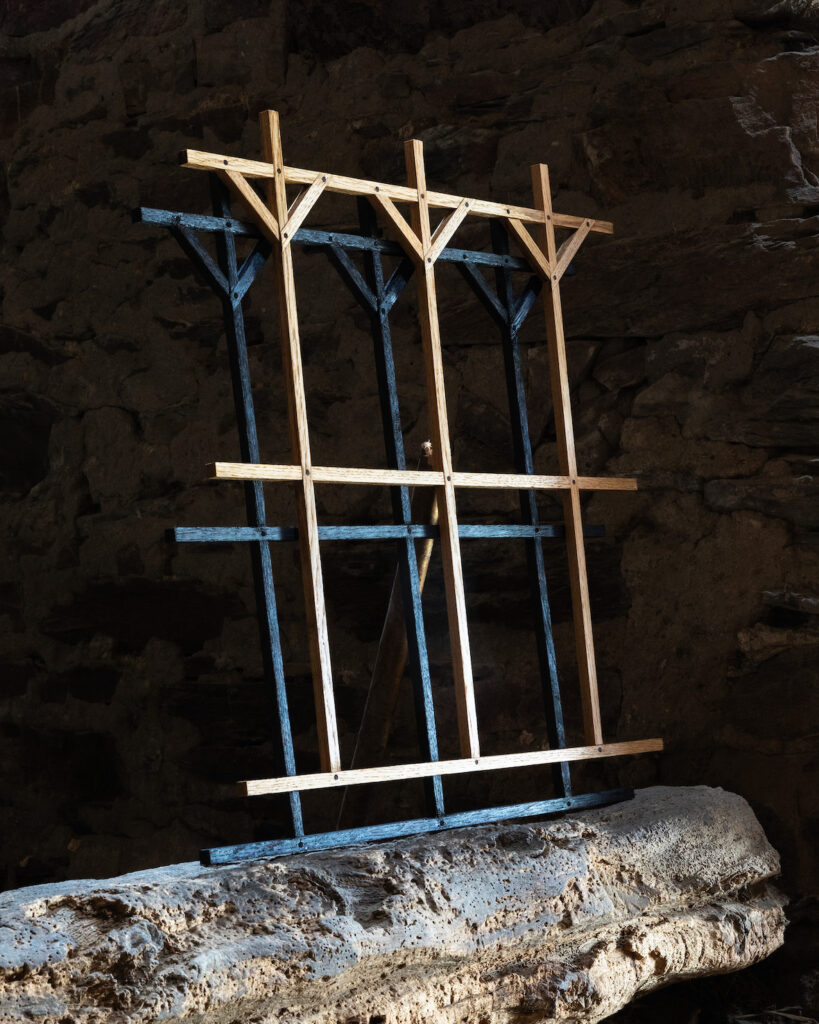
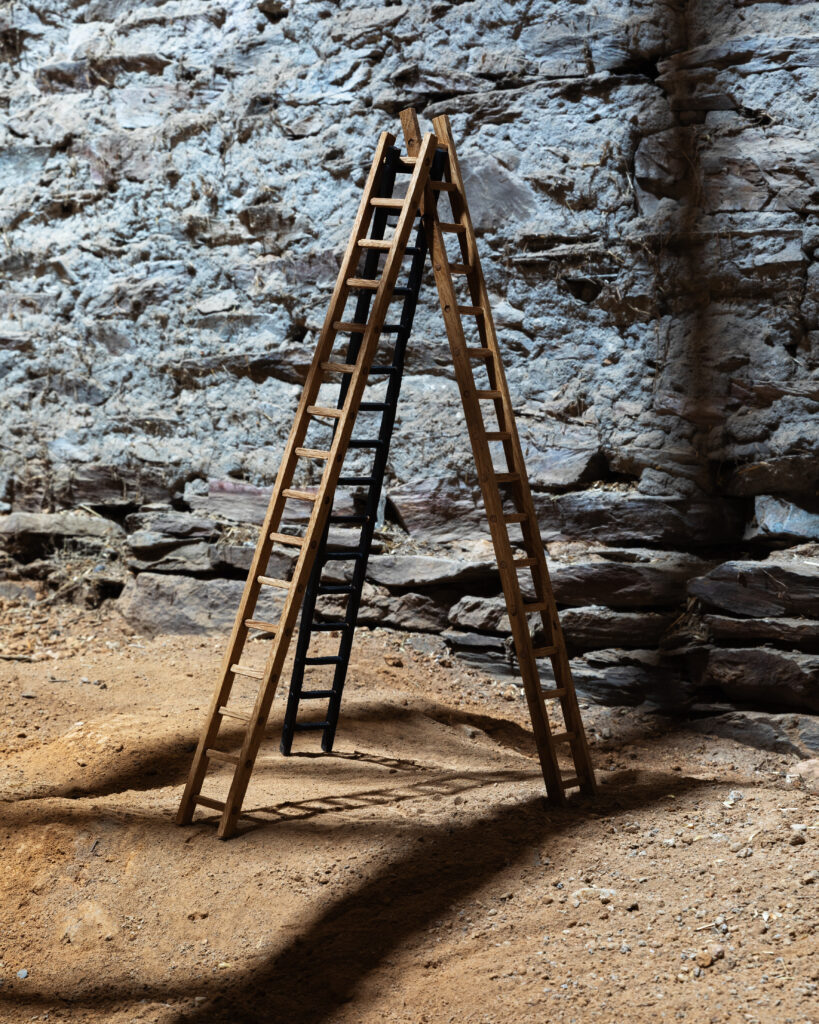
Nocturnes (2026) is an attempt to connect this inspiring workspace, steeped in history, which was left virtually intact after the sale of the farm complex, with the sculptural studies I developed during my artist residency at this location. I was curious to see how I could relate the clay floors, the weathered roof beams, the bricks baked by the farmer himself — objects that bear witness to a life that has been connected to the surrounding landscape for generations — to my own wooden models and objects.
In the series of photographs, smoothly sanded and oiled wooden surfaces alternate with the fire- and woodworm-damaged wooden beams of the barn and the weathered paintwork of the farmhouse. For me, the series is an attempt, both as an artist and as a temporary guest, to use the materials of this place to connect with the users of the building who preceded me here
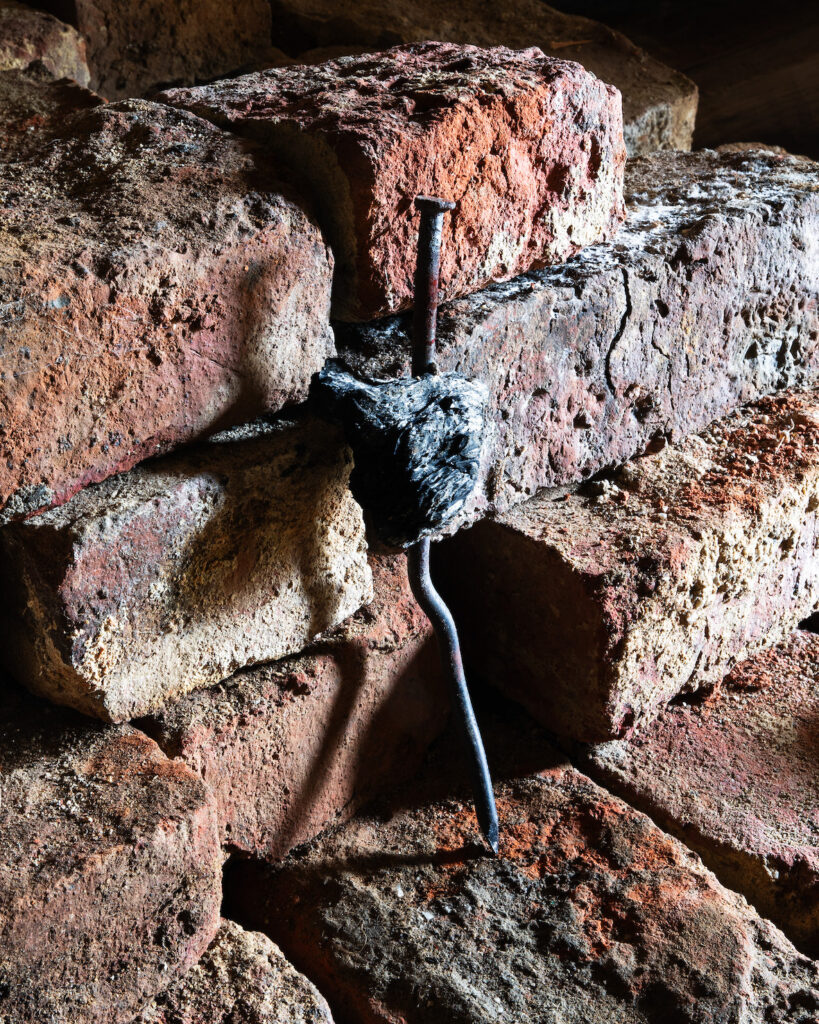
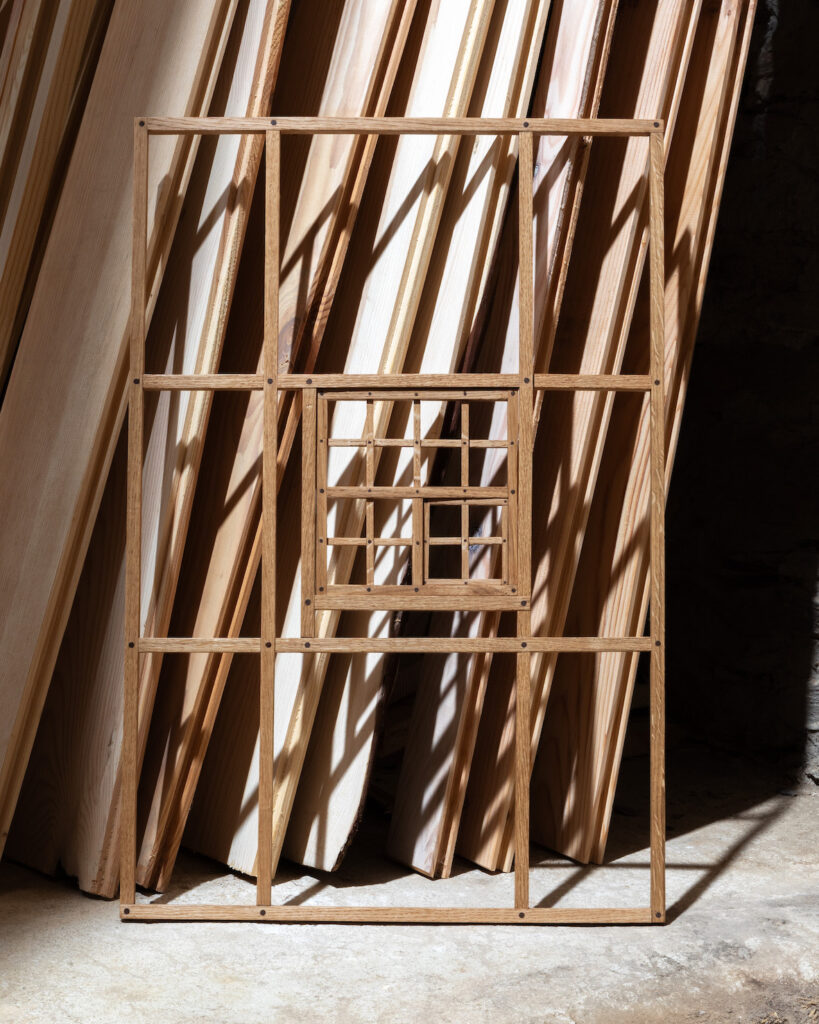
A vanished staircase, a burnt roof, a deep blue hue hidden under a thick layer of lime, the shadow of one ladder over another. They form both a concrete reason for new work and a representation of the lives and stories that were probably never recorded in archives. They are objects of unpretentious beauty that would probably have been thrown away with the rubbish during many other house sales and subsequent renovations.
It is interesting to see the strong connection between architecture and the immediate surrounding landscape in this place, for example the connection between Schreiner Harry and his forest, but also between the houses’ brickwork and the local quarries. We are losing this connection in more and more places. Due to globalisation and capitalism, villages and cities around the world have become increasingly similar. Houses, apartment complexes and city streetscapes across continents have become so homogenous that they could easily be located almost anywhere. Tanizaki already expressed his dissatisfaction with these processes in his 1933 essay. With comfortable progress and growing prosperity, the spaces in which we live have become increasingly alike, seemingly interchangeable.
Without wanting to fall into a longing for the past, when things were supposedly better, it is interesting to consider what’s been lost by whitewashing walls and hiding wooden structural beams. There was something in the progressive thinking of the 20th century that wanted to break with this dark, wooden past. When houses are renovated, old wooden floors regularly emerge from underfloor coverings, plastered ornaments from under suspended ceilings and solid wooden staircases from under laminate flooring. It is precisely these kinds of architectural details that we value today. These authentic elements drive up the value of houses, entire neighbourhoods and cities. Perhaps these elements are primarily a testament to our own liberal efficiency mindset and the cheap, large-scale and, above all, anonymous and interchangeable architecture that it produced. Perhaps that’s why we now cling so tightly to authentic architectural elements from the past.
In this farm complex, I see a direct geological connection between the house and the landscape. A connection that cannot be replaced. Had this farm been located in a different landscape, it would have definitely looked different. The formation of basalt and slate in the nearby Vulkaneifel has determined the appearance of the walls. The ochre-red pigment, extracted from iron-rich rocks from the same mining area, was the most readily available colour for painting furniture, window frames and stairs. The trees from the forests surrounding the village can literally be found in the old furniture, the walls and roofs of the houses. In contemporary construction, this balance between people, house and landscape has been disrupted; building materials are sourced from all over the world, arriving in mass loads in shipping containers. One landscape serves another; it is exploited, and thus old colonial relationships continue to exist.
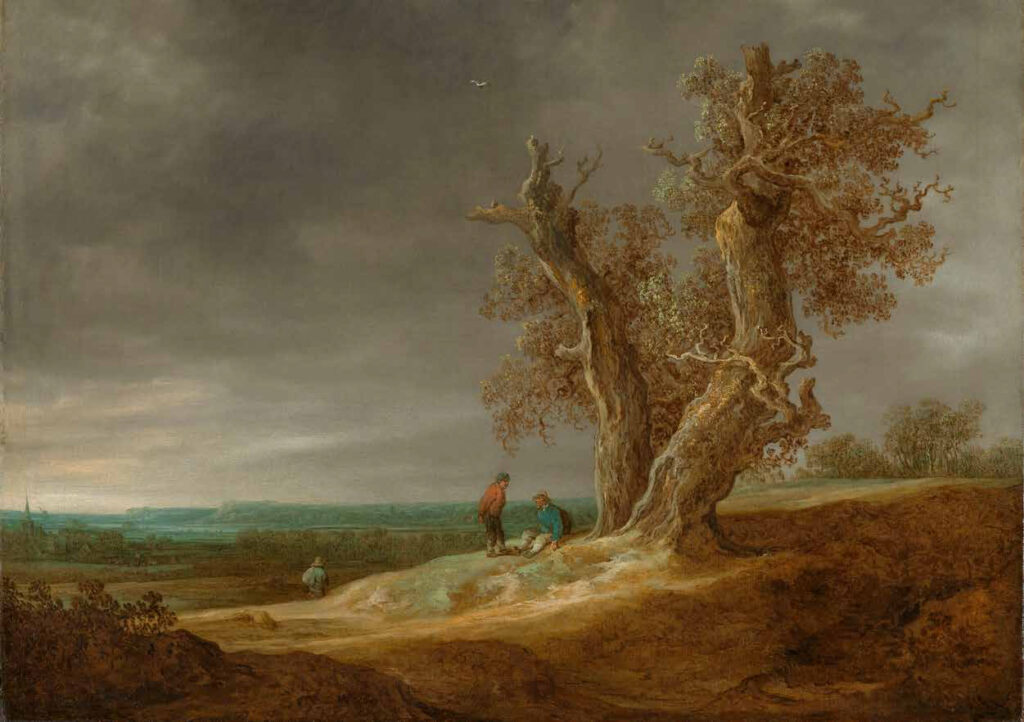
I think of the disappearance of the primeval Dutch forests, the last tree of which disappeared forever in 1871 from the Beekbergerwoud near Apeldoorn, one of many European primeval forests that disappeared. Dutch place names ending in -woud, -wold, -laar, -rode and -loo (clearing in the forest) are ‘toponyms’ that refer to the wooded environment from which they originated. These forests have largely disappeared from the earth, but still live on in the form of place names.
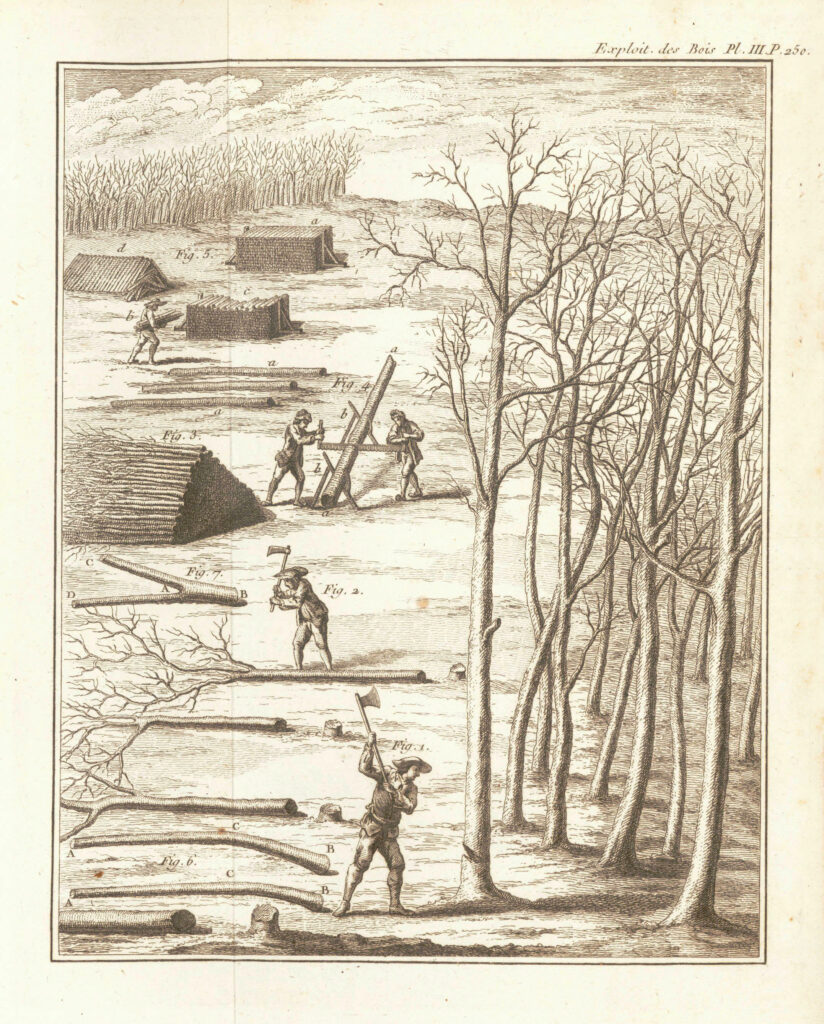
As I walk through the woods surrounding the village along the banks of the Brohlbach, I watch the water flowing with me towards the lower-lying Mosel river. In a few weeks’ time, some of this very water will flow beneath my feet when I take the ferry across the IJ to Amsterdam-Noord. Suddenly I realise that there is an important historical connection between the Netherlands and these German forests that I had overlooked until now.
Downstream
The floating vessels of the Rheinflößerei, or Höllanderflöße, were hundreds of metres long and many metres deep. These immense floating islands provided work for hundreds of rowers and other personnel on board these rafts, carrying downstream entire forests from areas such as the Rhineland, the Black Forest and Alsace. Wood from forests along the Rhine was also transported via tributaries such as the Mosel, Mainz and Neckar rivers. The German town of Koblenz, located near Brohl, as well as Mannheim, Mainz and Wesel, were important hubs in this major logistics operation. They were transit points where smaller rafts and bundles of logs were combined into the monstrous vessels that had timber merchants in cities such as Dordrecht, Amsterdam and Zaandam in the lower reaches of the river as their final destination
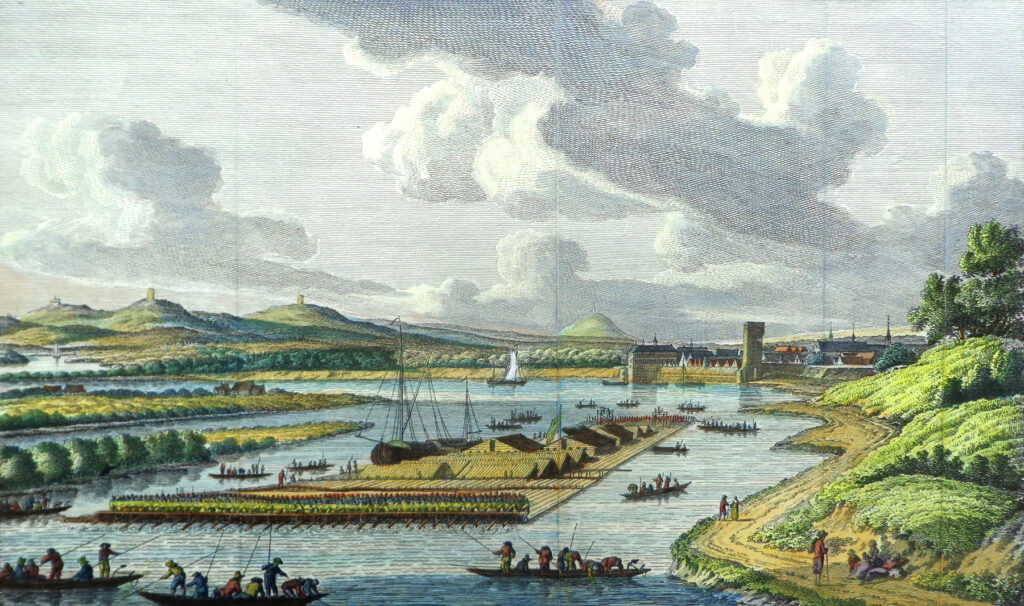
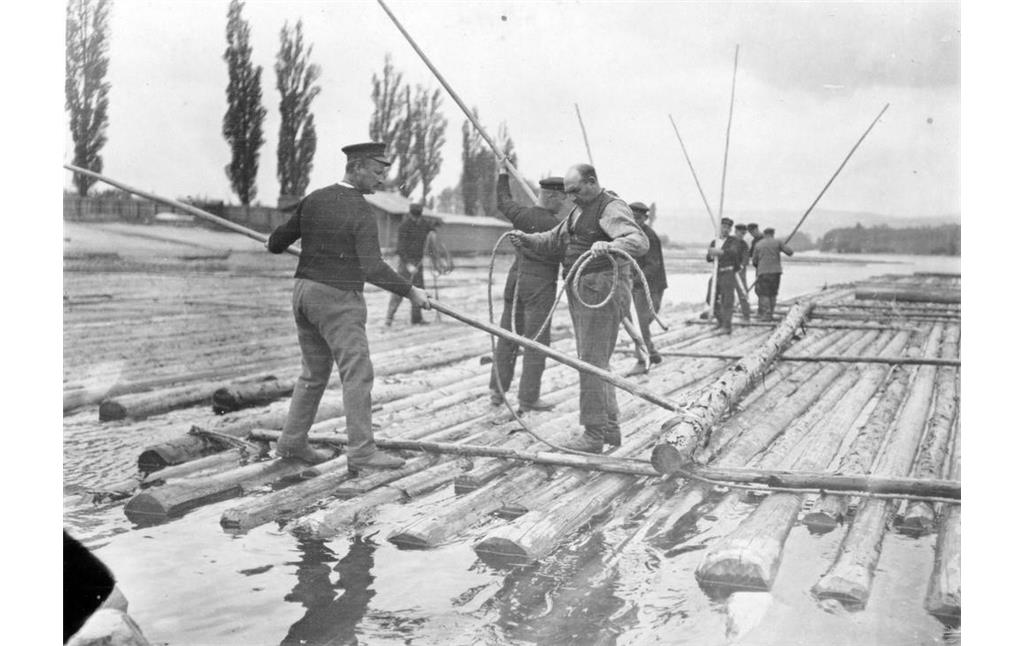
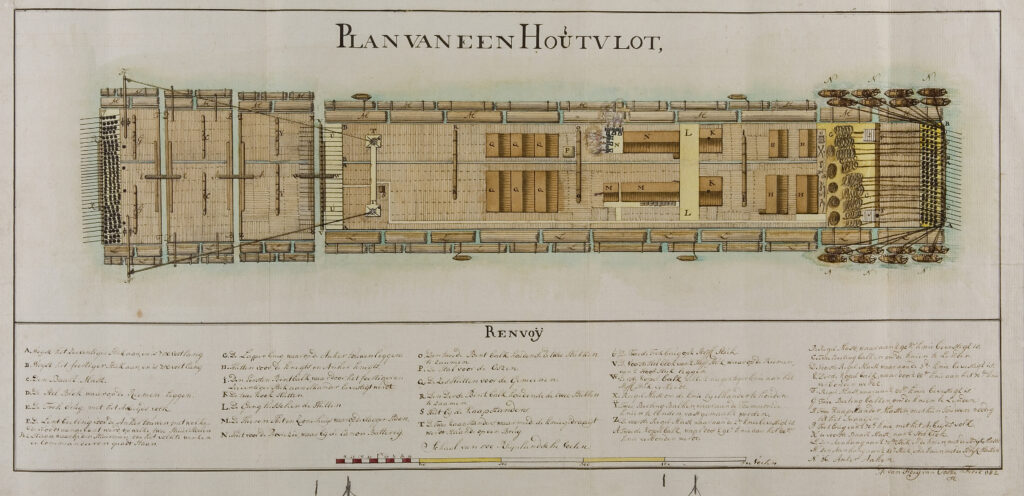
The timber from these rafts would form the foundations for buildings erected on top of the marshy Dutch peat soil, making these German forests indispensable for the development of numerous Dutch cities. Amsterdam is the best-known example, but other Dutch cities such as Utrecht, The Hague, Leiden, Delft and Hoorn were also built on wooden pile foundations. These stilts were made using oak, spruce and pine trees from these German regions, but also from an even larger medieval timber trade network. Timber merchants brought wood from Norway and Sweden, Poland and the Baltic States to Dutch territory to be processed by sawmills. ‘Holländer’, is what the Germans called the straight, often 30-metre-long ‘Kiefer’, spruces and pines that could be driven into the ground upon arrival of the Höllanderflöße.
The timber trade with Germany and the Baltic region proved essential to the violent colonial plundering in overseas territories. These European forests were indispensable for economic and urban development, but they were also the driving force behind the Netherlands as a powerful shipping nation and the exploitative capitalism and brutal colonial relations that resulted from this. Names of places such as Houthavens, Houtkopersburgwal and Haarlemmer Houttuinen are reminders of the enormous wood supply that came from the upstream areas of the rivers and the Baltic Sea region.
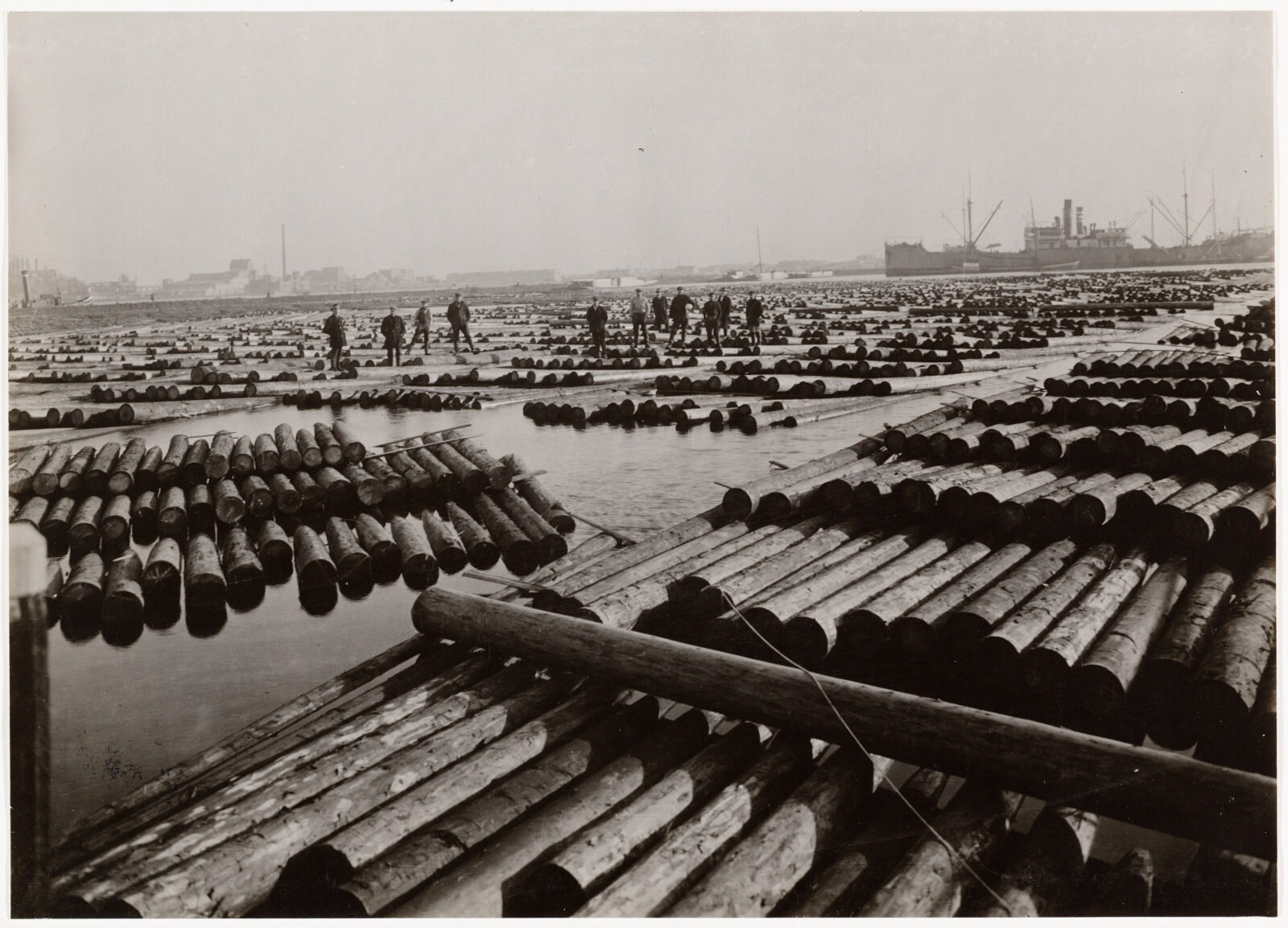
‘It is a forest of tall mills of various types, swinging their enormous, crossed arms; and above the houses and churches, they create a commotion and swarm like a flock of monstrous birds flapping their wings above the city’[7], is how Italian writer Edmondo De Amicis described the city of Amsterdam in 1893. By the end of the 19th century, a ring of more than one hundred sawmills had formed on the outskirts of Amsterdam, of which Molen de Otter in Amsterdam-West is currently the last of its kind.
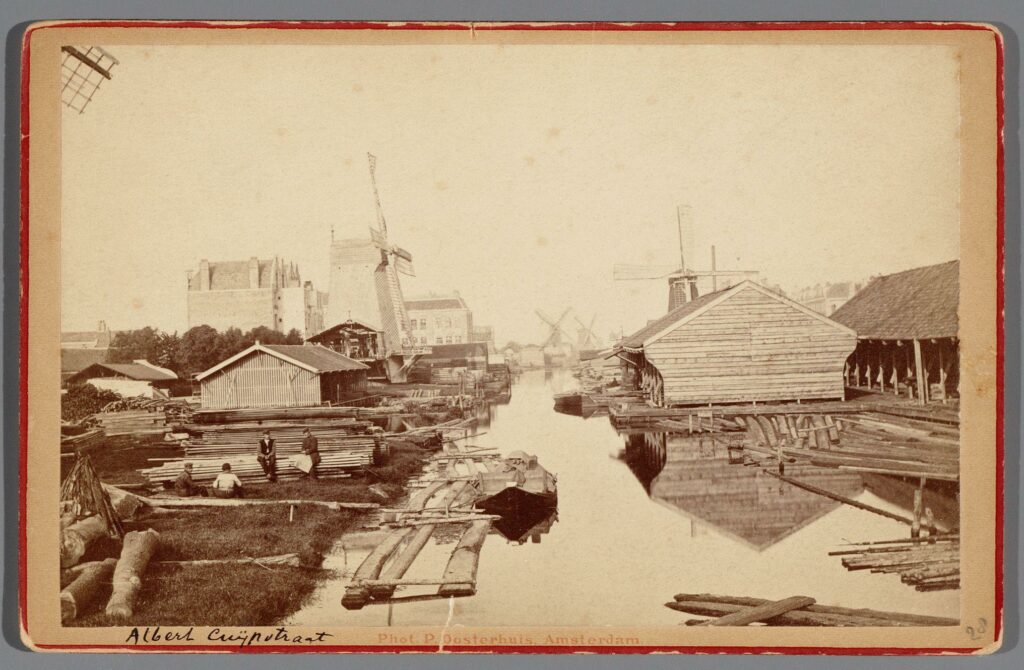
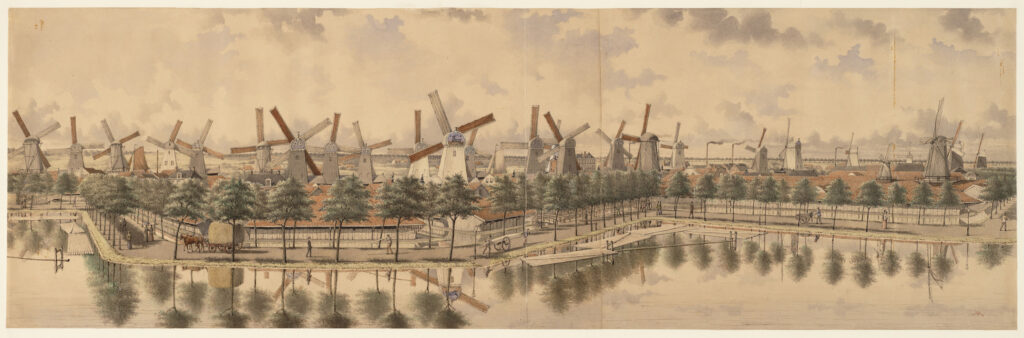
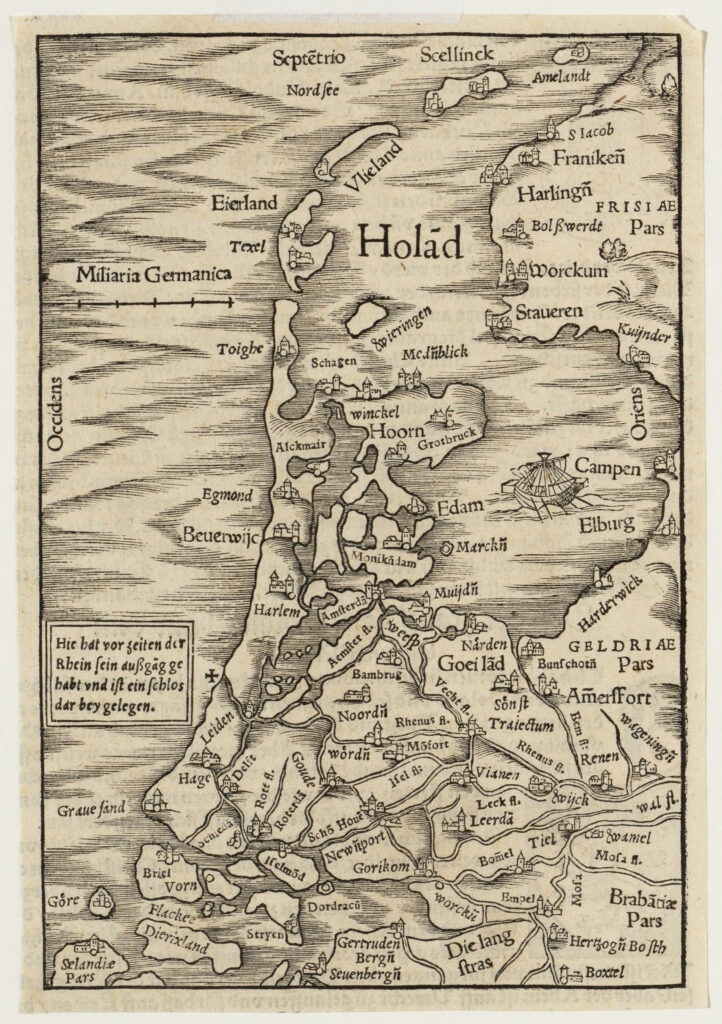
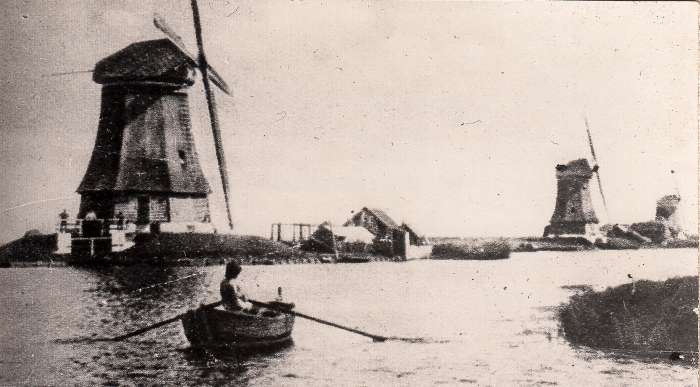
In the heyday of the Zaanse Schans, which is considered the oldest still-operational industrial area in Europe, there were 600 windmills turning simultaneously, sawing wood from forests across Europe into beams and planks. On the site in Zaandam where I have my studio — where I am currently writing the text for this publication as well as sawing, sanding and finishing my own wood (German oak) to make new sculptures — stood De Waker (The Guard), De Dromer (The Dreamer) and De Slaper (The Sleeper) until 1914. Three poetic names for the three mills that stood here on this site, pumping water from the surrounding lakes to create new land. The wood from German forests not only enabled the building of new cities and of overseas pillaging, but also enabled new land to be created. The disappearance of the old forest landscape led to the creation of a new polder landscape, and with it came the emergence of many new farms, houses and churches. These trees ensured that the Swiss cheese that was the Dutch landscape (fig.1) could be transformed into the landscape we know today.
In bringing my experiences in the rural German Rhineland-Pfalz areas back to the Netherlands, I am following in the footsteps of the many foresters, timber merchants, skippers and millers who came before me. The photographs and sculptural objects that came downstream with me are testimony to the connections between these areas. They just needed to be rediscovered.
Sometimes all it takes is a centimetre of wall surface to be removed to remind you that we are only a small link in the great collective of the city. With the same feeling with which people look at a starry sky, the lifting of a floorboard or the peeling away of a piece of wallpaper can ‘open a hole in time’. That idea sits at the heart of my artistic practice, the idea that there are always multiple rooms within a single space; that architecture changes with us over time, thus itself becoming human and acquiring its own memory. You can apply this artistic and archaeological perspective to everything in your own living environment. The underground forests, hidden wooden beams or a concealed layer of blue paint quietly remind us that there is not just one city, but a kaleidoscopic pattern of cities within cities, houses within houses and rooms within rooms.
—
Footnotes
[1] The process by which land or buildings sink to a lower level.
[2] Underground columns on which the timber frame construction rested.
[3] Traditional German title for joiner or carpenter.
[4] Higher cultural elements that originate in the upper classes but ‘sink’ down to the common people.
[5] Taubenblau (dove blue) is a common type of blue in German rural architecture. For a long time, it was thought that this type of blue, also known as fly blue, would repel insects. It was therefore used not only in kitchens and bedrooms, but also in agricultural areas such as barns and stables, to protect livestock and crops from insects.
[6] Recesses in the timberwork under the roof ridge, which allowed owls access to the barn to hunt mice; there are all kinds of myths and folk tales surrounding owl holes.
[7] Een woud van molens, article by historian Niels Wisman.
—
Bart Lunenburg is a visual artist and regularly writes about the research behind his visual projects. He previously wrote the essays Wakers op de drempel – over bezit enbescherming in historische landelijke architectuur and Vertrekken – te gast in het huis van architectJože Plečnik (1872-1957), both of which were published by Mister Motley.
With special thanks to Wilfried Lentz and Carla de Kovel for their hospitality, peeling back the construction layers, and the valuable conversations.
This essay is also available in publication format in Dutch and English. Published by Soft concern and hard concern (ISBN 9789083521138).
https://www.ideabooks.nl/All/?manufacturer=bee67047d02b4d06a292057864a379a6
https://soft-concern.com/
This publication was published on the occassion with the solo exhibition The Sound of Night Falling in the Other Room, Galerie Caroline O’Breen, Amsterdam (14.02–21.03.26). Works from this research will be on display concurrently during the Warmoes Biennale, Amsterdam (07.03-03.05.26) and the exhibition Stairway to? – Stairs and Ladders at Kunsthal KAdE, Amersfoort (31.01-10.05).
This publication is part of the research project Jaarringen and would not have been possible without the generous support of the Amsterdam Fund for the Arts and the Mondriaan Fund.
Ook adverteren op mistermotley.nl? Stuur dan een mail naar advertenties@mistermotley.nl